
EL34 vs 6L6: What Are the Sound Differences?
Quick answer: EL34 and 6L6 are different power-tube families. EL34 tubes are true power pentodes, while 6L6GC tubes are beam-power devices. Listeners often associate EL34 circuits with stronger midrange character and 6L6 circuits with more headroom and firmer bass, but the amplifier circuit and output transformer usually matter more than the tube name alone.
Comparisons between EL34 and 6L6 tubes are common in guitar and home-audio discussions. The descriptions can be useful, but they become misleading when the effect of the amplifier circuit is ignored.
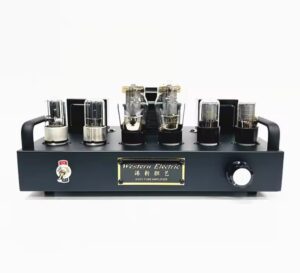
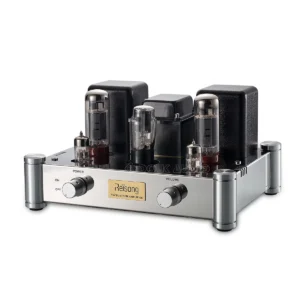
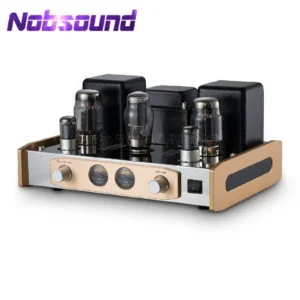
Nobsound EL34 Valve Tube Power Amplifier HiFi Class A Stereo Desktop Audio Amp
The same tube can behave differently depending on plate voltage, bias, feedback, transformer design, operating mode and speaker load. EL34 and 6L6 tubes are also not universal drop-in replacements.
EL34 vs 6L6 at a Glance
| Characteristic | EL34 | 6L6GC |
|---|---|---|
| Device type | Power pentode | Beam-power tube |
| Typical maximum plate dissipation | About 25 W for common EL34 types | About 30 W for common 6L6GC types |
| Common subjective description | Forward mids, texture and earlier compression | More headroom, broader bass and cleaner presentation |
| Typical uses | British-style guitar amps and many hi-fi designs | American-style guitar amps and many hi-fi designs |
| Interchangeability | Only in amplifiers designed to support it | Only in amplifiers designed to support it |
What Is an EL34?
The EL34 is an octal-base audio power pentode. JJ Electronic lists a maximum plate dissipation of 25 watts for its standard EL34. It is used in push-pull and single-ended amplifiers and is strongly associated with classic British guitar-amplifier designs.
In home audio, the EL34 can be used in ultralinear, pentode or triode-connected operation. Each arrangement changes power, output impedance and distortion.
What Is a 6L6GC?
The 6L6GC is an octal beam-power tube designed for audio-frequency power amplification. JJ Electronic lists 30 watts of plate dissipation for its 6L6GC type. The family is strongly associated with American guitar amplifiers, but it is also widely used in hi-fi equipment.
The 6L6 family includes several variants with different ratings. A 6L6GC should not automatically be treated as equivalent to every older 6L6 version.
Commonly Reported Sonic Differences
EL34 sound descriptions
- More prominent or textured midrange
- Earlier sense of compression when driven
- Softer or less dominant extreme bass in some circuits
- A more immediate presentation in many classic designs
6L6 sound descriptions
- Greater clean headroom in many amplifiers
- Stronger or more controlled bass
- A wider and more relaxed presentation
- Smoother upper midrange in some circuits
Affiliate disclosure: TubeDecoded may earn a commission from selected product links. This does not change the technical conclusion that tube behavior depends on the complete amplifier circuit.
Why the Circuit Matters More Than the Label
Tube type is only one variable. Negative feedback, transformer bandwidth, power-supply regulation, output impedance and the bias point can alter the audible result as much as or more than changing between tube families.
An EL34 amplifier with high feedback and wide-bandwidth transformers may sound more neutral than a low-feedback 6L6 amplifier. A poorly matched output transformer can also dominate the final frequency response.
Can You Replace EL34 with 6L6?
Only when the amplifier manufacturer explicitly supports both families. The tubes share an octal base, but pin use, bias requirements, heater current, screen-grid limits and optimal transformer loading differ.
Amplifiers with automatic bias and selectable operating modes may support several tube families. In a fixed-bias amplifier, changing tubes can require a bias adjustment. Never assume that physical fit means electrical compatibility.
Safety warning: Tube amplifiers contain lethal internal voltages. Bias adjustment and internal measurement should be performed only by people trained to work safely with high-voltage electronics.
Which Tube Is Better for Home Audio?
Neither family is universally better. Choose the amplifier rather than the tube name. Consider the quality of the transformers, circuit design, noise, output power, speaker compatibility, service support and whether the amplifier can use currently available replacement tubes.
Which Tube Has More Power?
The 6L6GC commonly has a higher plate-dissipation rating than a standard EL34, but actual amplifier output depends on circuit topology, supply voltage, transformer load and distortion limits. A well-designed EL34 push-pull amplifier can produce more power than a conservative 6L6 design.
Final Verdict
TubeDecoded conclusion: EL34 amplifiers are often chosen for midrange character and a more immediate presentation, while 6L6 amplifiers are often associated with headroom and solid bass. Treat these as tendencies, not guarantees. The complete amplifier design remains the decisive factor.