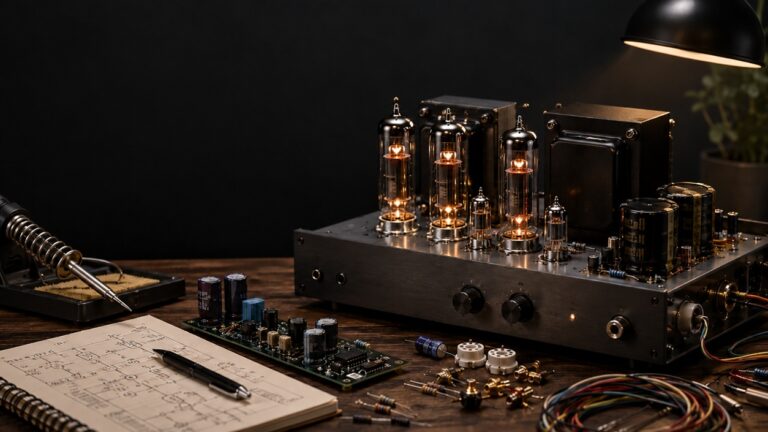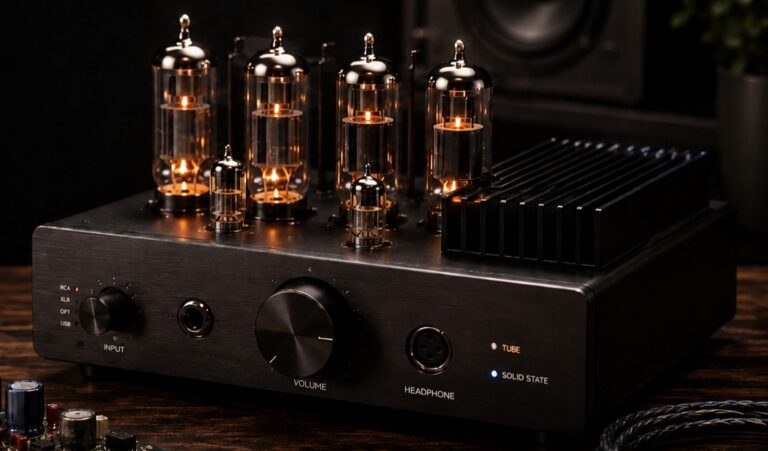
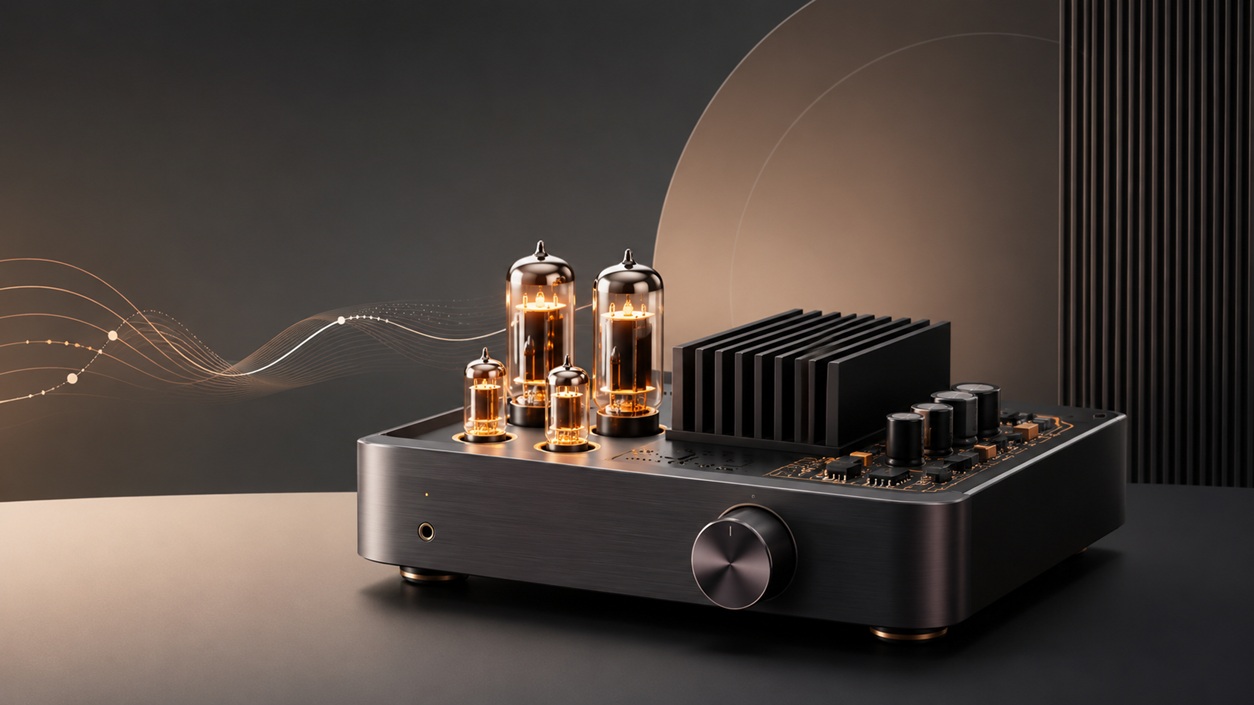
What Is a Hybrid Tube Amplifier?
A hybrid tube amplifier combines vacuum tubes with solid-state electronics. The tubes normally handle part of the signal amplification, while transistors, operational amplifiers or Class D circuits provide buffering or output power.
Hybrid tube amplifiers are common in affordable desktop audio systems because they can provide replaceable tubes, compact dimensions and useful output power without requiring the large transformers found in traditional all-tube amplifiers.
They are available as headphone amplifiers, preamplifiers and integrated speaker amplifiers. Many models also include Bluetooth, USB audio, optical input, tone controls and remote operation.
A hybrid design is not automatically fake or inferior. The important questions are whether the tubes are electrically active, what function they perform and whether the amplifier is suitable for the connected headphones or speakers.
How Does a Hybrid Tube Amplifier Work?
A hybrid amplifier divides the amplification process between vacuum tubes and semiconductor components.
A common arrangement works like this:
- The audio signal enters through an analog or digital source.
- A DAC converts digital audio into an analog signal when required.
- Vacuum tubes amplify, buffer or modify the analog signal.
- A solid-state output stage supplies current to headphones or speakers.
- The amplified signal reaches the connected audio equipment.
The exact design varies. In some products, the tube stage provides meaningful voltage gain. In others, it operates mainly as a buffer between the source and power amplifier.
The solid-state section may use discrete transistors, operational amplifiers or an integrated Class D power-amplifier chip.
Common Hybrid Amplifier Designs
Tube preamp with Class D speaker output
This is one of the most common designs in compact integrated amplifiers.
The tubes operate before the power-amplifier stage, while a Class D chip supplies the current required by passive speakers.
Examples include the Douk Audio X1 and AIYIMA T9 Pro.
Tube voltage stage with transistor headphone output
In this arrangement, the tubes increase the signal voltage and transistors provide the output current required by headphones.
This can provide broader headphone compatibility than some completely tube-based circuits.
The xDuoo MT-602 is an example of this architecture.
Tube buffer with solid-state amplification
A tube buffer may provide little or no voltage gain. Its purpose is to isolate circuit stages or alter the electrical behavior of the signal path.
The final amplification is performed by solid-state electronics.
Tube preamplifier with separate power amplifier
A standalone tube preamplifier can be connected to a separate solid-state power amplifier.
Products such as the Fosi Audio P3 can feed active speakers or an external power amplifier but cannot drive passive speakers directly.
Are Hybrid Tube Amplifiers Real Tube Amps?
Yes, provided the vacuum tubes are electrically active in the audio circuit.
The term hybrid simply means that both tube and solid-state technologies are used. It does not mean that the tubes are decorative.
However, some inexpensive products emphasize glowing tubes without clearly explaining their function. Buyers should look for documentation showing:
- The exact tube model
- The location of the tube stage
- The solid-state output device
- The amplifier’s inputs and outputs
- The operating voltage of the tubes
- A clear circuit or functional description
A manufacturer that identifies both the tube stage and power-amplifier chip normally provides a clearer explanation than a listing that simply says tube sound.
Hybrid vs Full-Tube Amplifiers
| Feature | Hybrid tube amplifier | Traditional full-tube amplifier |
|---|---|---|
| Amplification devices | Tubes and solid-state electronics | Primarily or entirely vacuum tubes |
| Speaker-output stage | Usually transistor or Class D | Power tubes with output transformers |
| Typical size | Compact | Larger |
| Weight | Usually light | Often heavy |
| Heat | Moderate | Usually high |
| Efficiency | Usually higher | Usually lower |
| Speaker power | Often high relative to size | Usually lower unless the amplifier is large |
| Bluetooth and DAC | Common | Less common |
| Maintenance | Usually small-signal tube replacement | May require power tubes and bias adjustment |
| Purchase price | Generally lower | Generally higher |
Advantages of Hybrid Tube Amplifiers
Lower price
Hybrid designs avoid the large output transformers and multiple power tubes required by many traditional tube amplifiers.
This allows manufacturers to offer tube-based products at considerably lower prices.
Compact size
Class D output stages and external power supplies allow the enclosure to remain small.
This makes hybrid amplifiers suitable for desks, bedrooms and small living-room systems.
Higher efficiency
A modern solid-state output stage wastes less power as heat than many traditional tube circuits.
The amplifier may therefore provide more speaker power from a smaller power supply.
Modern connectivity
Hybrid amplifiers frequently include:
- Bluetooth
- USB audio
- Optical input
- Coaxial input
- Remote control
- Subwoofer output
- Bass and treble controls
Replaceable tubes
Many hybrid amplifiers use socketed small-signal tubes. These can be replaced when worn or exchanged for compatible alternatives.
Broader headphone compatibility
A transistor output stage can supply more current than many small tube circuits. This can make hybrid headphone amplifiers suitable for a wider range of impedances.
Disadvantages of Hybrid Tube Amplifiers
Not a traditional tube output stage
Buyers seeking power tubes, output transformers and a conventional tube speaker amplifier may be disappointed by a hybrid design.
Tube contribution may vary
The audible or measurable influence of the tubes depends on the circuit. In some products, the tube stage has a larger effect than in others.
Marketing can be unclear
Marketplace listings sometimes describe hybrid products as pure tube amplifiers without explaining the solid-state output stage.
Headline power figures can be misleading
Compact Class D amplifiers often advertise the maximum capability of the power chip rather than realistic continuous output from the included adapter.
External power supplies vary
The same amplifier may be sold with different power adapters. The selected voltage and current capacity can influence available output power.
Do Hybrid Tube Amplifiers Sound Like Tube Amps?
They can exhibit some characteristics associated with tube circuits, but there is no universal hybrid tube sound.
The result depends on:
- The role of the tubes
- The tube operating voltage
- The amount of gain in the tube stage
- The solid-state output circuit
- The installed tubes
- The source
- The connected speakers or headphones
- The listening volume
Terms such as warm, smooth and analog are subjective. A tube buffer operating at a low voltage may behave differently from a high-voltage tube gain stage.
The only reliable way to understand a product is to examine its circuit, measurements and controlled listening results.
Does a Hybrid Amp Need Output Transformers?
Most compact hybrid amplifiers do not use tube output transformers.
The solid-state output stage can connect to headphones or speakers using conventional semiconductor amplifier circuits.
Removing large output transformers reduces:
- Weight
- Size
- Manufacturing cost
- Shipping cost
A traditional all-tube speaker amplifier normally requires output transformers unless it uses a specialized transformerless design.
Can a Hybrid Tube Amp Power Passive Speakers?
Some can and some cannot.
A hybrid integrated amplifier with speaker binding posts contains a solid-state power stage and can drive compatible passive speakers.
Examples include:
- Douk Audio X1
- AIYIMA T9 Pro
- Fosi Audio MC331
A tube preamplifier such as the Fosi Audio P3 cannot power passive speakers directly. It must feed active speakers or a separate power amplifier.
Always inspect the rear connections. RCA outputs are not speaker outputs.
Are Hybrid Tube Amps Good for Headphones?
Hybrid designs can be a practical choice for headphones because the tube stage can provide voltage gain while transistors supply output current.
This can be useful with:
- Low-impedance dynamic headphones
- High-impedance dynamic headphones
- Selected planar-magnetic headphones
- Desktop systems using an external DAC
Compatibility still depends on output power, output impedance, gain and noise.
Highly sensitive in-ear monitors may reveal background noise or provide too little usable movement on the volume control.
Can You Change the Tubes?
Many hybrid amplifiers use socketed tubes that can be replaced.
Common small-signal families include:
- 6J1
- 6AK5
- 5654 and 5654W
- EF95
- JAN5725
- 6N3
- 6N8P
These families are not universally interchangeable. The amplifier manufacturer must confirm compatibility.
Never install a tube only because it fits physically into the socket. Similar-looking tubes can have different heater requirements, pin arrangements and operating limits.
What Is Tube Rolling?
Tube rolling is the replacement of the original tubes with compatible alternatives.
Users may do this to:
- Replace noisy or worn tubes
- Improve channel balance
- Reduce microphonics
- Experiment with gain or distortion
- Investigate subjective tonal changes
Tube rolling does not guarantee better performance. A correctly matched and quiet inexpensive tube may perform better than an expensive collectible tube.
How to Identify a Hybrid Tube Amplifier
Look for the following signs:
- A small external DC power adapter
- A Class D chip such as TPA3250, TPA3255 or TDA7498E
- Small-signal tubes rather than large power tubes
- Bluetooth, USB or digital inputs
- High advertised speaker power from a compact enclosure
- No large output transformers
- A manufacturer description mentioning tube preamp and solid-state output
A compact amplifier powered by a 24 or 32 V adapter is very unlikely to be a traditional all-tube speaker amplifier.
How to Choose a Hybrid Tube Amplifier
1. Choose the correct product type
Decide whether you need a headphone amplifier, preamplifier or integrated speaker amplifier.
2. Check the inputs
List the sources you intend to connect. You may need RCA, Bluetooth, USB, optical, coaxial or phono input.
3. Check the outputs
Confirm whether the product has headphone output, passive-speaker terminals, preamplifier output or a dedicated subwoofer connection.
4. Identify the tube function
Look for a clear explanation of whether the tubes provide gain, buffering or another signal-processing function.
5. Check the power supply
Verify whether the adapter is included, its voltage and current rating, and the selected regional plug.
6. Evaluate realistic output power
Do not compare only headline wattage. Consider the supplied power adapter, speaker impedance and distortion conditions.
7. Confirm tube availability
Check the included tube model and the price and availability of compatible replacements.
Common Buying Mistakes
- Assuming every product with visible tubes is completely tube-based
- Buying a preamplifier for passive speakers
- Choosing a speaker amplifier when headphone output is required
- Ignoring the absence of an internal DAC
- Comparing only advertised maximum wattage
- Using the wrong power adapter
- Replacing tubes without verifying compatibility
- Assuming every analog input is a phono input
- Buying a balanced amplifier without balanced sources and cables
Hybrid Tube Amplifier Safety
Hybrid amplifiers usually operate at lower external supply voltages than traditional tube amplifiers, but they can still contain elevated internal voltages.
Follow these precautions:
- Disconnect power before replacing tubes.
- Allow tubes to cool before touching them.
- Use only the specified power adapter.
- Keep ventilation openings clear.
- Do not open the enclosure without technical training.
- Keep exposed tubes away from children and pets.
- Do not operate the amplifier near water.
Internal capacitors may retain a charge after the amplifier is disconnected. Do not assume that an external low-voltage adapter makes every internal circuit safe to touch.
Frequently Asked Questions
What does hybrid mean in a tube amplifier?
It means the amplifier uses both vacuum tubes and solid-state electronics in the audio circuit.
Are hybrid tube amplifiers fake?
No. They are legitimate tube amplifiers when the tubes are electrically active. They are called hybrid because the output or other circuit stages use semiconductors.
Do hybrid amplifiers use real vacuum tubes?
Many do. Check the exact tube model and manufacturer documentation to confirm the role of the tubes.
Can a hybrid tube amp power speakers?
Yes, when it includes a solid-state speaker-output stage and passive-speaker terminals. A hybrid preamplifier cannot power passive speakers.
Are hybrid tube amplifiers good for headphones?
They can be. A solid-state output stage can provide useful current while the tube section provides voltage gain or buffering. Check power, gain and noise before buying.
Do hybrid tube amplifiers need a DAC?
Some contain an internal DAC, while analog-only models require an external DAC for digital sources.
Do hybrid tube amplifiers sound warm?
Not always. The sound depends on the complete circuit, operating conditions, tubes, source, speakers or headphones and listening level.
Can I replace the tubes?
Many models use socketed replaceable tubes. Use only alternatives confirmed as electrically compatible.
Are hybrid amps better than full-tube amps?
Neither is universally better. Hybrid amplifiers are normally smaller, cheaper and more efficient. Full-tube amplifiers provide a traditional tube output stage.
Why do hybrid amplifiers advertise so much power?
Their solid-state Class D output chips can produce relatively high power from compact enclosures. Actual output still depends on the supplied voltage, current and load.
Final Explanation
A hybrid tube amplifier combines vacuum tubes with solid-state electronics. The tubes normally operate in the preamplifier, voltage-gain or buffer stage, while transistors or Class D chips provide the final output power.
This architecture allows manufacturers to offer compact and affordable amplifiers with modern inputs, replaceable tubes and enough power for many headphones or passive speakers.
The best hybrid amplifier is not necessarily the model with the most visible tubes or highest advertised wattage. It is the product that provides the correct inputs, outputs, power and compatibility for the intended system.
Hybrid tube amplifiers are a practical middle ground between traditional tube equipment and modern solid-state audio. They are genuine tube products when the valves are active, but buyers should always identify exactly what the tubes do.