What Is a Tube Amplifier?
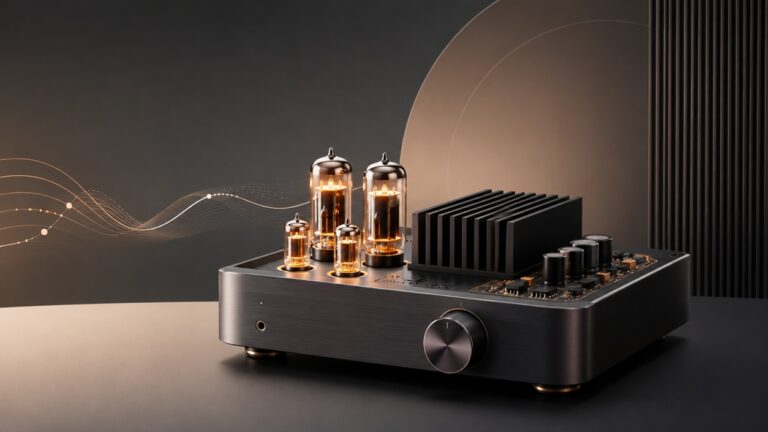
A tube amplifier is an audio amplifier that uses vacuum tubes, also called valves, to increase the strength of an audio signal. Depending on the design, tubes may be used in the preamplifier stage, power-output stage or both.
Tube amplifiers were widely used before transistors became common, but they remain popular in home audio, headphone systems, musical-instrument amplifiers and specialist audio equipment.
Some modern products are traditional all-tube amplifiers. Others are hybrid designs that combine vacuum tubes with transistors, operational amplifiers or Class D power-amplifier chips.
Understanding the difference is important because products described as tube amplifiers can perform very different jobs. A tube headphone amplifier, tube preamplifier and integrated tube speaker amplifier are not interchangeable.
How Does a Tube Amplifier Work?
A vacuum tube controls the movement of electrons inside a sealed glass or metal enclosure. The tube contains several internal elements, commonly including a cathode, control grid and plate.
The cathode is heated so that it releases electrons. These electrons move toward the positively charged plate. A small audio signal applied to the control grid changes the flow of electrons between the cathode and plate.
Because a relatively small change at the control grid can produce a larger change in plate current, the tube can amplify an audio signal.
Warms the cathode so it can release electrons.
Emits electrons when heated.
Controls the electron flow using the incoming audio signal.
Collects electrons and forms part of the amplified output circuit.
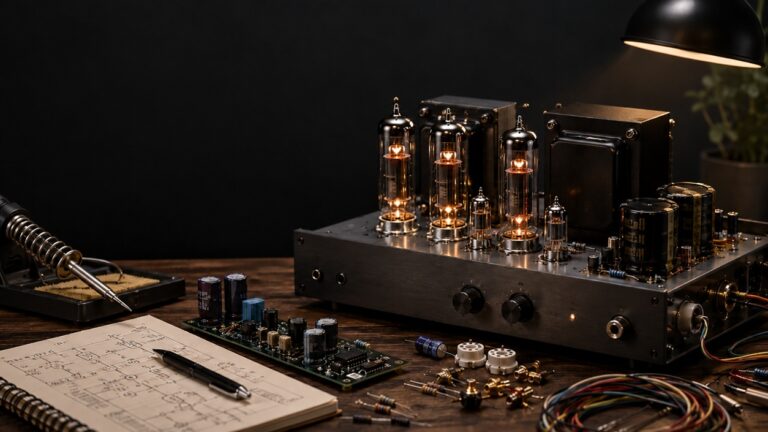
Real amplifier circuits also contain resistors, capacitors, transformers, power supplies and sometimes semiconductor components. The tubes are only one part of the complete amplifier.
Main Types of Tube Amplifiers
Tube preamplifier
A tube preamplifier increases a low-level audio signal and provides functions such as volume control, source selection or tone adjustment.
It does not normally provide enough power to drive passive speakers. It must be connected to a power amplifier, active speakers or another compatible component.
Examples include compact products such as the Fosi Audio P3 and Douk Audio P1.
Tube headphone amplifier
A tube headphone amplifier is designed to provide the voltage and current required by headphones.
Some are completely tube-based, while others use tubes for voltage amplification and transistors for the output stage.
Examples include the xDuoo MT-602, xDuoo TA-26S and Nobsound NS-08E.
Tube power amplifier
A tube power amplifier increases a line-level signal sufficiently to drive passive speakers.
Traditional designs use power tubes and output transformers. The output transformer converts the relatively high-voltage, low-current tube output into a form suitable for a low-impedance loudspeaker.
A power amplifier normally requires a separate preamplifier or source with volume control.
Integrated tube amplifier
An integrated amplifier combines a preamplifier and power amplifier in one enclosure.
It normally includes source selection, volume control and passive-speaker outputs. Some modern models also include Bluetooth, USB, optical input, a DAC or a phono stage.
The Willsenton R8 is an example of a traditional integrated tube amplifier. The Douk Audio X1 and AIYIMA T9 Pro are hybrid integrated amplifiers.
Phono tube preamplifier
A phono preamplifier increases the extremely low signal produced by a turntable cartridge and applies the required RIAA frequency equalization.
MM and MC cartridges have different output levels and loading requirements. A phono stage designed for moving-magnet cartridges should not automatically be assumed to support a low-output moving-coil cartridge.
What Is a Hybrid Tube Amplifier?
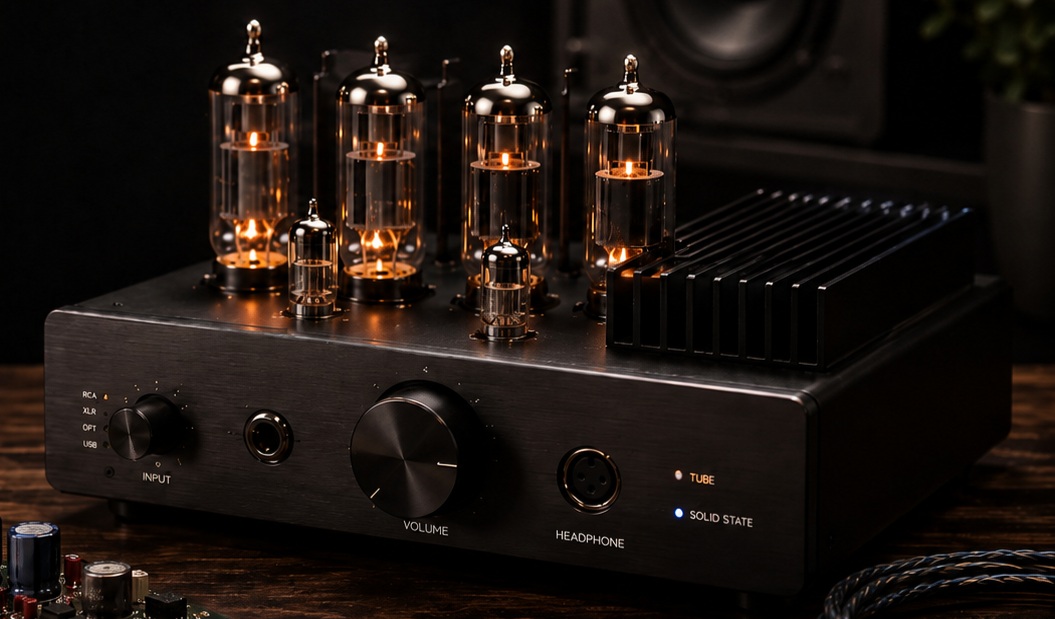
A hybrid tube amplifier combines vacuum tubes and solid-state electronics in the same device.
Common hybrid arrangements include:
- Tube preamplifier with a Class D speaker-output stage
- Tube voltage stage with transistor headphone output
- Tube buffer between a DAC and power amplifier
- Tube circuit combined with Bluetooth and digital processing
Hybrid amplifiers are popular because they can be smaller, cooler, less expensive and more powerful than traditional all-tube products of a similar size.
A hybrid amplifier is not fake merely because it contains transistors. The important question is whether the tubes are electrically active and whether the manufacturer explains their role accurately.
All-Tube vs Hybrid Amplifiers
| Feature | Traditional all-tube amplifier | Hybrid tube amplifier |
|---|---|---|
| Signal amplification | Primarily or entirely performed by tubes | Shared between tubes and solid-state components |
| Speaker-output stage | Power tubes and output transformers | Usually transistors or Class D chips |
| Size | Usually larger | Usually more compact |
| Weight | Often heavy because of transformers | Usually lighter |
| Heat | Usually high | Usually lower |
| Efficiency | Generally lower | Generally higher |
| Digital inputs | Less common | Bluetooth, USB and optical are common |
| Typical price | Higher | Lower |
| Maintenance | Power tubes may require replacement and bias adjustment | Usually limited to small-signal tubes |
Why Do People Like Tube Amplifiers?
Different distortion characteristics
Tube circuits can produce a different distortion profile from many solid-state amplifiers, especially when approaching their output limits.
Some listeners describe this as warm, smooth or forgiving. These descriptions are subjective and depend heavily on the specific circuit, output transformer, tubes, speakers and listening level.
Gradual overload behavior
Certain tube amplifiers move into distortion more gradually than some solid-state designs. This behavior is particularly valued in guitar amplifiers, where controlled distortion forms part of the intended sound.
In home audio, distortion is normally kept much lower, but the amplifier’s behavior close to clipping can still influence subjective impressions.
Replaceable components
Many tube amplifiers allow the user to replace the tubes. This makes maintenance possible without replacing the entire amplifier.
It also enables tube rolling, where compatible tubes are exchanged to investigate changes in noise, gain, distortion or subjective sound.
Visual appearance
The glow, glass construction and exposed layout of vacuum tubes provide a distinctive appearance that many buyers enjoy.
However, visual appeal should not replace analysis of circuit design, safety, connectivity and performance.
Historical and technical interest
Tube amplifiers connect modern listeners with an important part of audio and electronics history.
Their circuits are also interesting to enthusiasts who enjoy understanding biasing, transformers, power supplies and analog component behavior.
Do Tube Amplifiers Sound Better?
There is no universal answer. Sound quality depends on the complete system and not only on whether tubes or transistors are used.
Important factors include:
- Amplifier circuit design
- Output impedance
- Noise and distortion
- Power capability
- Speaker or headphone compatibility
- Source quality
- Room acoustics
- Listening level
- Personal preference
A well-designed solid-state amplifier can outperform a poorly designed tube amplifier. A carefully matched tube amplifier can also provide an enjoyable result in an appropriate system.
The presence of tubes alone does not guarantee better sound.
TubeDecoded may earn a commission when you purchase through links on this website. This does not increase the price you pay or determine our editorial explanations.
Tube Amplifier Advantages
- Distinctive circuit behavior and presentation
- Replaceable tubes
- Possibility of tube rolling
- Strong visual appeal
- Many simple analog circuit designs
- Historical and technical interest
- Useful voltage capability for some high-impedance headphones
- Gradual overload characteristics in selected designs
Tube Amplifier Disadvantages
- Higher heat output
- Lower electrical efficiency
- Tubes eventually require replacement
- Traditional designs can be large and heavy
- Output transformers can increase cost
- Some amplifiers require bias adjustment
- High internal voltages create a safety risk
- Output impedance may interact with speakers or headphones
- Background hum or tube noise may be audible
- Matching replacement tubes can increase maintenance cost
What Is Tube Rolling?
Tube rolling is the practice of replacing the installed tubes with electrically compatible alternatives.
Users may change tubes to:
- Replace a worn or noisy tube
- Improve channel balance
- Reduce microphonics
- Investigate different gain characteristics
- Experiment with subjective tonal differences
Tube rolling is not automatically an upgrade. Expensive old-stock tubes do not guarantee better performance.
Never install a tube simply because it fits the socket. Tubes with similar physical dimensions may use different pin assignments, heater voltages, current requirements or operating limits.
How Long Do Vacuum Tubes Last?
Tube life varies widely depending on the tube type, operating conditions, manufacturing quality and amplifier design.
Small-signal tubes can often operate for several thousand hours. Power tubes generally experience more electrical and thermal stress and may require replacement sooner.
Tube life can be reduced by:
- Excessive operating voltage or current
- Poor ventilation
- Frequent physical shock
- Incorrect bias
- Manufacturing defects
- Repeated extreme heating and cooling
A tube should not be replaced solely because it has reached a particular age. Noise, reduced output, imbalance, instability or measurement results provide better evidence that replacement may be needed.
Do Tube Amplifiers Need to Warm Up?
Vacuum tubes require a short period for their heaters and cathodes to reach operating temperature.
Many amplifiers begin producing sound within approximately 10 to 30 seconds. Some include a longer delay or protective mute circuit.
An amplifier does not normally need to remain powered for hours before it can be used. Follow the manufacturer’s instructions and avoid leaving tube equipment unattended.
Do Tube Amplifiers Use More Electricity?
Traditional tube amplifiers are generally less efficient than modern solid-state and Class D designs.
Energy is consumed by:
- Tube heaters
- High-voltage power supplies
- Bias current
- Transformer losses
- Heat generation
A traditional tube amplifier may consume substantial power even when playing quietly. Compact hybrid products are usually more efficient because the speaker-output stage uses transistors or Class D amplification.
Can Tube Amplifiers Power Any Speaker?
No. The amplifier and speaker must be matched appropriately.
Important speaker characteristics include:
- Nominal impedance
- Minimum impedance
- Sensitivity
- Required listening level
- Room size
- Listening distance
Many traditional tube amplifiers provide separate output terminals for 4-ohm and 8-ohm speakers. Use the connection recommended by the amplifier manufacturer.
Low-powered tube amplifiers are generally easier to use with efficient speakers. Insensitive speakers in a large room may require considerably more power.
Are Tube Amplifiers Good for Headphones?
Tube amplifiers can work very well with headphones, but compatibility depends on the amplifier architecture.
Some output-transformerless tube amplifiers are particularly suitable for high-impedance dynamic headphones. Their relatively high output impedance may be less appropriate for low-impedance headphones or sensitive in-ear monitors.
Hybrid headphone amplifiers can provide lower output impedance and more current, making them compatible with a wider range of headphones.
Do not rely only on the published impedance range. Also consider headphone sensitivity, required voltage, required current and background-noise sensitivity.
Can a Tube Preamp Power Speakers?
A tube preamplifier cannot normally power passive speakers directly.
It produces a line-level signal that must be connected to:
- A separate power amplifier
- An integrated amplifier
- Active speakers
- An active subwoofer with a suitable input
Product listings sometimes use the word amplifier without clearly distinguishing between a preamplifier and speaker power amplifier. Always inspect the available outputs before purchasing.
How to Identify a Traditional Tube Power Amplifier
A traditional tube speaker amplifier usually includes:
- One or more power tubes per channel
- Large output transformers
- A substantial mains transformer
- Passive-speaker terminals
- High internal operating voltages
- Significant weight and heat output
Compact products powered by a small external DC adapter are usually hybrid amplifiers, preamplifiers or headphone amplifiers rather than traditional tube power amplifiers.
This does not make compact products inferior. It simply means they use a different architecture.
How to Choose a Tube Amplifier
1. Decide what you need to power
Determine whether the amplifier must drive headphones, active speakers or passive speakers.
2. Identify your source connections
Check whether you need analog RCA, USB, optical, coaxial, Bluetooth or a phono input.
3. Choose between traditional and hybrid designs
Traditional tube amplifiers provide tube power-output stages but are usually larger and more expensive. Hybrid amplifiers provide more connectivity and power for the price.
4. Check speaker or headphone compatibility
Consider impedance, sensitivity, power requirements and the amplifier’s measured or published output capability.
5. Verify the power supply
Confirm the mains-voltage version, regional plug, included adapter and required DC voltage.
6. Check replacement tube availability
Research the included tube types, replacement cost and manufacturer-supported alternatives.
7. Consider warranty and returns
Heavy tube amplifiers can be expensive to return internationally. Review the seller, warranty terms and local service options.
Are Cheap Tube Amplifiers Real?
Some inexpensive products contain functioning tubes, while others use tubes in a limited buffer stage. A few products may emphasize tube lighting and appearance more than meaningful tube operation.
To evaluate a low-cost product, look for:
- A clear circuit description
- The exact tube model
- Manufacturer documentation
- Input and output specifications
- Information about the solid-state output stage
- Realistic power claims
- Independent measurements when available
A product can be a legitimate hybrid amplifier even when the tubes do not provide the final output power.
Tube Amplifier Safety
Traditional tube amplifiers may contain internal voltages high enough to cause fatal electric shock. Capacitors can retain a dangerous charge after the amplifier has been disconnected from power.
Basic precautions include:
- Do not open the enclosure without appropriate high-voltage training.
- Disconnect power before replacing tubes.
- Allow tubes to cool before touching them.
- Keep ventilation openings clear.
- Keep the amplifier away from children and pets.
- Do not operate it near water.
- Use the correct mains-voltage version.
- Use only correctly rated fuses and power adapters.
- Do not leave exposed tube equipment unattended for long periods.
Frequently Asked Questions
What does a tube amplifier do?
It increases the strength of an audio signal using one or more vacuum tubes. Depending on the design, it may drive headphones, feed another amplifier or power passive speakers.
Is a valve amplifier the same as a tube amplifier?
Yes. Vacuum tube is the common term in North America, while valve is commonly used in the United Kingdom and other regions.
Are hybrid tube amplifiers genuine tube amplifiers?
Yes, when the tubes are electrically active in the audio circuit. Hybrid means that tubes and solid-state electronics share the amplification work.
Do tube amplifiers need special speakers?
Not always, but the speakers must be compatible with the amplifier’s output power, impedance connections and current capability. Efficient speakers are useful with low-powered tube amplifiers.
Can I leave a tube amplifier on all day?
It is generally better to switch it off when it will not be used for an extended period. This reduces electricity consumption, heat and tube wear.
How often do tubes need replacing?
There is no fixed interval. Small-signal tubes can often last several thousand hours, while power tubes may wear more quickly. Replace them based on condition, symptoms and measurements rather than age alone.
Do tube amplifiers require maintenance?
They may require tube replacement, cleaning and, on some models, power-tube bias adjustment. Always follow the manufacturer’s instructions.
Why are tube amplifiers expensive?
Traditional models require high-voltage power supplies, output transformers, substantial metalwork, manual assembly and replaceable tubes. Shipping costs can also be high because of their weight.
Can a tube amplifier connect to Bluetooth?
Some modern tube and hybrid amplifiers include Bluetooth. Traditional analog models require a separate Bluetooth receiver.
Can a turntable connect directly to a tube amplifier?
Only when the amplifier includes a compatible phono input or the turntable contains a built-in phono preamplifier. Otherwise, a separate phono stage is required.
Final Explanation
A tube amplifier uses vacuum tubes to increase an audio signal. The tubes may operate in the preamplifier stage, output stage or both.
Traditional tube amplifiers use power tubes and output transformers to drive speakers. Hybrid tube amplifiers combine tubes with transistors or Class D circuits to reduce size, cost, heat and power consumption.
Neither design is automatically better. The correct choice depends on the source, headphones or speakers, required connectivity, available space and budget.
Do not choose an amplifier only because it has visible tubes. Identify what the tubes actually do, confirm that the product can power your equipment and compare the complete circuit, connections, power supply and safety information.