Fosi Audio P3 Review
This is a research-based review using official manufacturer documentation, published specifications and product-listing analysis. We have not physically tested this product unless this page is later updated to state otherwise.
The Fosi Audio P3 is a compact tube preamplifier, Bluetooth receiver and headphone amplifier designed for desktop audio systems.
It accepts either Bluetooth or a conventional analog RCA source. Its outputs can feed headphones, active speakers, a separate power amplifier or another compatible line-level audio component.
Two replaceable 5654W vacuum tubes operate in the preamplifier circuit. Fosi states that the internal tube operating voltage reaches 54 volts, distinguishing the P3 from inexpensive products that use visible tubes primarily for decoration.
The P3 does not contain a speaker power amplifier or digital-to-analog converter. It cannot power passive speakers directly, and it does not accept USB, optical or coaxial digital audio.
The Fosi Audio P3 is a practical and affordable tube preamp for active speakers, separate power amplifiers and moderately demanding headphones. Bluetooth, tone controls and replaceable tubes make it flexible, but its headphone output is not especially powerful and it lacks USB, optical and passive-speaker connections.
Active speakers, separate power amplifiers and desktop headphones
Tube preamplifier, Bluetooth receiver and headphone amplifier
Multiple analog outputs, Bluetooth and replaceable 5654W tubes
No DAC or passive-speaker power output
Check the current Fosi Audio P3 price
Fosi Audio P3 Specifications
| Product type | Tube preamplifier and headphone amplifier |
|---|---|
| Included tubes | Two replaceable 5654W vacuum tubes |
| Tube operating voltage | Up to 54 V according to Fosi Audio |
| Inputs | Bluetooth 5.1 and stereo RCA |
| Outputs | Stereo RCA, 3.5 mm AUX and 3.5 mm headphone output |
| Bluetooth chip | Qualcomm QCC3031 |
| Bluetooth codecs | SBC, AAC, aptX, aptX HD and aptX Low Latency |
| Published Bluetooth range | At least 10 meters under suitable conditions |
| Headphone impedance range | 16-300 ohms according to Fosi Audio |
| Headphone output at 16 ohms | 250 mW |
| Headphone output at 32 ohms | 150 mW |
| Headphone output at 250 ohms | 32 mW |
| Headphone output at 300 ohms | 20 mW |
| Frequency response | 20 Hz-20 kHz, ±1 dB |
| Published THD | 0.02% or less |
| Published signal-to-noise ratio | At least 103 dB |
| Dynamic range | 104 dB |
| Published crosstalk | 95 dB |
| Published noise floor | 64 microvolts |
| Treble adjustment | ±6 dB |
| Bass adjustment | ±12 dB |
| Power supply | DC 12 V / 1.5 A |
| Internal DAC | No |
| Passive-speaker output | No |
| Remote control | No |
What Is the Fosi Audio P3?
The P3 combines three main functions:
- A tube stereo preamplifier
- A Bluetooth 5.1 audio receiver
- A compact headphone amplifier
It can sit between an audio source and a separate power amplifier or pair of active speakers. It can also drive compatible headphones directly through its front 3.5 mm output.
Typical system arrangements include:
- Phone via Bluetooth to P3 to active speakers
- External DAC to P3 to power amplifier to passive speakers
- Streamer to P3 to active speakers
- CD player to P3 to headphones
- P3 AUX output to an active subwoofer or other compatible equipment
The P3 is not a speaker power amplifier. Passive speakers require a separate amplifier such as the Fosi Audio V3, ZA3 or another compatible model.
Is the Fosi Audio P3 a Real Tube Preamp?
Fosi Audio describes the P3 as a genuine tube preamplifier and states that the tube circuit operates at up to 54 volts.
The two 5654W tubes are active components in the preamplifier stage rather than purely decorative lights.
This does not mean the entire device is made exclusively from tube circuitry. Bluetooth processing, power regulation and headphone-output functions also require solid-state electronics.
The most accurate description is therefore a tube preamplifier combined with modern solid-state Bluetooth and headphone-support circuitry.
Design and Controls
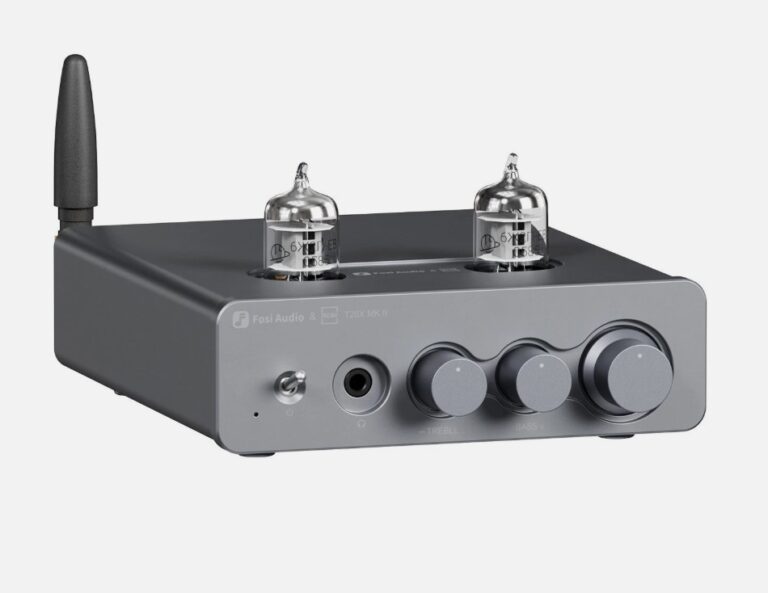
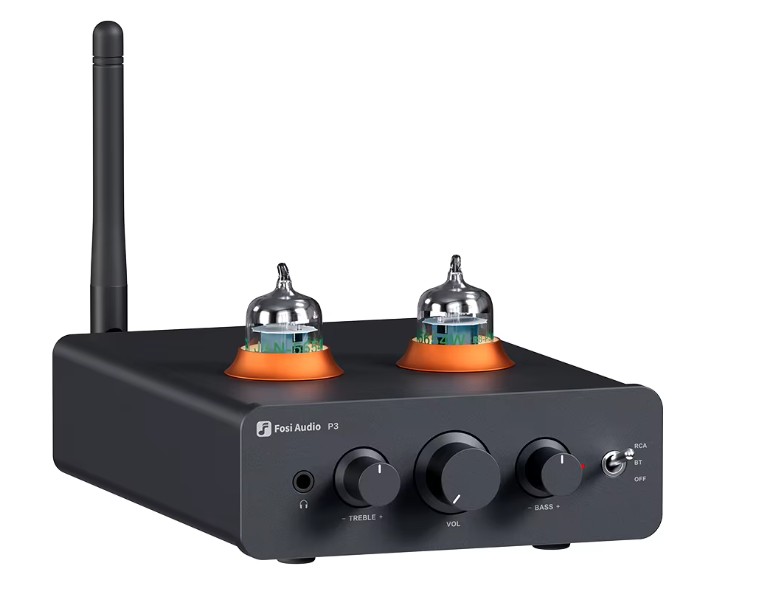
The P3 uses a compact metal enclosure with two visible seven-pin tubes mounted through the top panel.
The front panel includes:
- 3.5 mm headphone output
- Volume control
- Treble control
- Bass control
- Power and input-selection switch
- Input-status indicator
The rear panel includes:
- Stereo RCA input
- Stereo RCA output
- 3.5 mm AUX output
- Bluetooth antenna connection
- Bluetooth reset button
- DC 12 V power input
The bass and treble controls have center detents. Returning both controls to their center positions provides the neutral adjustment setting.
The P3 does not provide a separate tone-bypass switch, so the controls remain within the signal path even when centered.
Bluetooth Performance
The P3 uses a Qualcomm QCC3031 Bluetooth receiver supporting SBC, AAC, aptX, aptX HD and aptX Low Latency.
The transmitting phone, tablet or computer must support the same codec. The connection will otherwise use another mutually supported format.
Bluetooth Low Latency can reduce delay, but both the transmitter and receiver must support it. Modern phones do not universally support every aptX format.
Bluetooth is useful for:
- Casual music playback
- Streaming from a smartphone
- Adding wireless audio to active speakers
- Connecting a computer without running a long analog cable
The Bluetooth reset button can clear the stored connection when another device has paired accidentally. Hold the reset control for approximately three seconds.
RCA Analog Input
The rear RCA input accepts a conventional line-level signal from an external DAC, streamer, CD player, television converter or other analog audio component.
It is not a phono input. A turntable requires a built-in phono stage or a separate external phono preamplifier before connecting to the P3.
Connecting a conventional turntable cartridge directly will normally result in a very quiet signal with incorrect frequency equalization.
RCA and AUX Outputs
The P3 provides stereo RCA and 3.5 mm AUX line outputs. These can be used to connect compatible active speakers, a separate power amplifier or another line-level device.
The outputs do not provide enough power for passive speakers. Any connected speaker must either contain its own amplifier or receive power from a separate speaker amplifier.
The AUX connection may be convenient for an active subwoofer or compact active speaker, depending on the available input and crossover arrangement of the connected equipment.
Check the connected subwoofer’s manual before assuming that the AUX output provides dedicated low-frequency filtering. A conventional full-range preamplifier output is not the same as a filtered subwoofer output.
TubeDecoded may earn a commission when you purchase through links on this page. This does not increase the price you pay or determine our editorial conclusions.
Headphone Output
The front 3.5 mm output allows the P3 to function as a headphone amplifier.
Fosi Audio publishes the following output ratings:
- 250 mW at 16 ohms
- 150 mW at 32 ohms
- 32 mW at 250 ohms
- 20 mW at 300 ohms
These specifications show that available power falls as headphone impedance increases. High-impedance headphones may receive sufficient voltage for moderate listening but substantially less power than low-impedance models.
The P3 should be viewed primarily as a preamplifier with a convenient headphone output, rather than as a high-power specialist headphone amplifier.
Headphone Compatibility
Fosi Audio specifies compatibility with headphones from 16 to 300 ohms. This broad range does not guarantee ideal performance with every headphone.
Also consider:
- Headphone sensitivity
- Required voltage
- Required current
- Driver technology
- Desired listening volume
- Background-noise sensitivity
Efficient dynamic headphones should generally be easier to drive than inefficient planar-magnetic models.
Highly sensitive in-ear monitors may reveal background noise or channel imbalance close to the lowest position of the analog volume control.
Full-size headphones with a 6.35 mm plug require an adapter because the P3 provides only a 3.5 mm socket.
Tube Configuration and Tube Rolling
The P3 is supplied with two 5654W seven-pin vacuum tubes.
Fosi Audio lists several compatible tube families, including:
- 5654 and 5654W
- 6AK5
- 6J1
- 6J4
- 6K4
- GE5654
- Other electrically compatible seven-pin alternatives
Tube rolling may change:
- Noise level
- Channel balance
- Gain
- Distortion characteristics
- Subjective tonal presentation
A different tube is not automatically an improvement. Condition, authenticity, electrical compatibility and manufacturing consistency can matter more than price.
Never install a tube merely because it fits the socket. Confirm that the electrical characteristics and pin arrangement are compatible with the P3.
How to replace the tubes
- Turn the P3 off.
- Disconnect the 12 V power adapter.
- Allow both tubes to cool completely.
- Remove each tube carefully without bending its pins.
- Align the pins with the socket openings.
- Insert each replacement gently without forcing it.
- Reconnect the amplifier and begin testing at low volume.
Tube Warm-Up Time
Fosi Audio advises allowing approximately 15 seconds for the tubes to warm after switching the P3 on.
A short delay before audio appears can therefore be normal. If there is still no sound after the warm-up period, check:
- That both tubes are inserted correctly
- That the correct input mode is selected
- That the power supply is connected
- That all audio cables are fully inserted
- That the source is producing audio
- That the volume is raised gradually
Bass and Treble Controls
The P3 provides separate bass and treble controls. Fosi specifies approximately ±12 dB for bass and ±6 dB for treble.
Tone controls can be useful for:
- Compensating for small speakers
- Reducing excessive brightness
- Adjusting recordings with weak bass
- Listening quietly when bass appears less prominent
Large boosts should be used carefully. Increasing bass demands more output from the connected power amplifier, speakers and headphone stage and may cause audible distortion sooner.
Using the P3 with Active Speakers
The P3 is well suited to active speakers because it provides volume control, Bluetooth, tone adjustment and several output options.
A typical connection is:
- Connect the P3 RCA output to the active speakers.
- Set the speaker volume to a moderate fixed position.
- Begin with the P3 volume low.
- Play music and gradually raise the P3 volume.
- Adjust the speaker level if the P3’s useful volume range is too narrow.
Avoid setting both the active speakers and P3 unnecessarily high, since this may increase noise or make accidental volume changes more severe.
Using the P3 with a Power Amplifier
The P3 can provide source selection, Bluetooth, volume control and tone adjustment for a separate power amplifier.
This is particularly useful with compact power amplifiers that have no input selection or front volume control.
Connect the P3 RCA output to the power amplifier input. Turn the P3 volume down before switching on the system, then increase it gradually.
The P3 does not replace the power amplifier. The separate amplifier remains responsible for driving passive speakers.
Power Supply
The official package includes a DC 12 V / 1.5 A power adapter. Fosi states that the P3 accepts a suitable 12 V supply rated between approximately 1.5 and 3 A.
Before using a replacement adapter, verify:
- DC 12 V output
- Adequate current capacity
- Correct connector dimensions
- Correct polarity
- Appropriate regional AC plug
A power supply with a higher current rating does not force excess current into the P3, provided the voltage, polarity and connector are correct. A higher voltage can damage the product.
Expected Sound
TubeDecoded does not assign a definitive sound signature without controlled listening tests and measurements.
Fosi markets the P3 as providing a warm and rich presentation. These descriptions are subjective and should not replace measurements or direct comparison.
The final result will depend on:
- The connected headphones or speakers
- The external DAC or analog source
- The installed tubes
- The bass and treble settings
- The power amplifier
- The listening volume
- The recording and room acoustics
The tubes may influence distortion and frequency behavior, but visible valves do not automatically guarantee a particular sound.
Pros and Cons
Advantages
- Two replaceable 5654W vacuum tubes
- Tube operating voltage of up to 54 V
- Bluetooth 5.1 with aptX HD and aptX Low Latency
- RCA and AUX line outputs
- 3.5 mm headphone output
- Separate bass and treble controls
- Can feed active speakers or a separate power amplifier
- Compact desktop enclosure
- Bluetooth reset function
- Affordable entry into tube rolling
Limitations
- Cannot power passive speakers
- No built-in DAC
- No USB audio input
- No optical or coaxial input
- No full-size 6.35 mm headphone output
- Modest headphone power at higher impedances
- No remote control
- No dedicated phono input
- No balanced input or output
- No separate tone-control bypass
Who Should Buy the Fosi Audio P3?
The P3 is best suited to:
- Users with active speakers
- Owners of a separate power amplifier
- Listeners wanting to add Bluetooth to an analog system
- Buyers interested in replaceable 5654W-family tubes
- Desktop headphone systems using efficient headphones
- Systems requiring simple bass and treble adjustment
- Users who already own an external DAC
Who Should Not Buy It?
Consider another product when you need:
- Direct passive-speaker amplification
- A built-in USB DAC
- Optical or coaxial television input
- A powerful specialist headphone amplifier
- A balanced headphone output
- A built-in phono stage
- A remote control
- A 6.35 mm headphone connection without an adapter
Fosi Audio P3 Alternatives
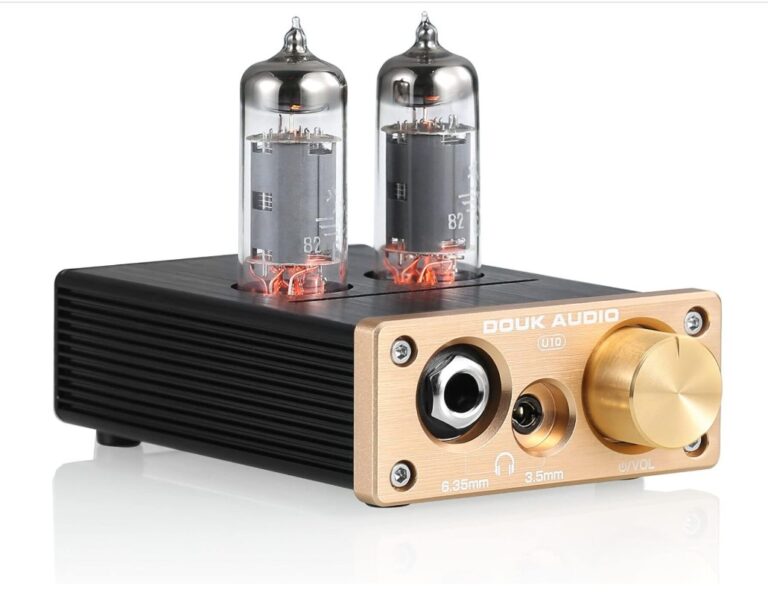
Douk Audio P1
Consider the Douk Audio P1 when USB audio and an internal DAC are required in addition to Bluetooth, tube preamplification and headphone output.
Fosi Audio MC331
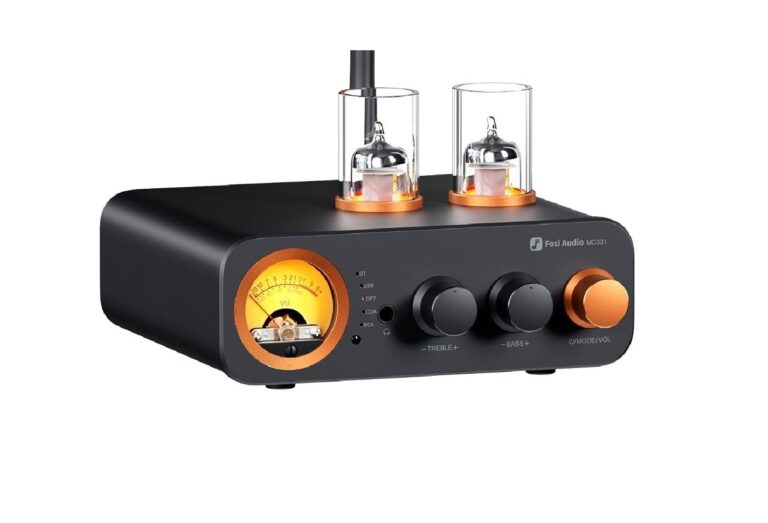
Consider the Fosi Audio MC331 when you need one unit that can accept digital sources and power passive speakers.
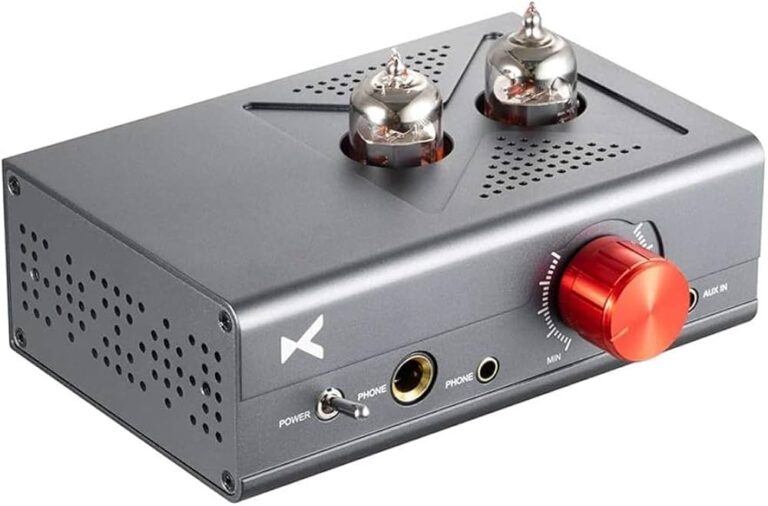
xDuoo MT-602
Consider the xDuoo MT-602 when headphone amplification is the main priority and you do not need Bluetooth or tone controls.
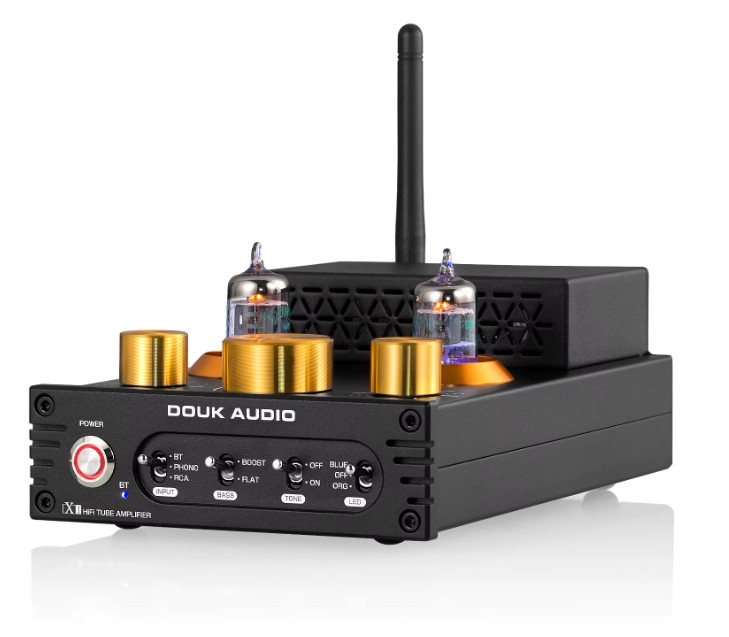
Douk Audio X1
Consider the Douk Audio X1 when you need passive-speaker output and an integrated MM phono stage for a compatible turntable.
What to Check Before Ordering
- Confirm that the listing is for the Fosi Audio P3.
- Check that two 5654W tubes are included.
- Verify that the Bluetooth antenna is included.
- Confirm whether the DC 12 V / 1.5 A power supply is included.
- Select the correct regional power plug.
- Remember that the P3 does not include a DAC.
- Remember that it cannot power passive speakers.
- Check whether your headphones require a 3.5-to-6.35 mm adapter.
- Verify that your source provides Bluetooth or analog RCA output.
- Review recent seller ratings and customer photographs.
- Compare the final price including VAT and shipping.
Disconnect the P3 from power and allow the tubes to cool before replacing them. Avoid connecting or disconnecting audio cables while the product is powered, since this can produce loud noises or damage connected equipment.
Frequently Asked Questions
Is the Fosi Audio P3 a real tube preamp?
Fosi Audio describes it as a genuine tube preamplifier and specifies an internal tube operating voltage of up to 54 volts.
Can the Fosi Audio P3 power passive speakers?
No. It must be connected to active speakers or a separate power amplifier before it can be used with passive speakers.
Does the P3 have a built-in DAC?
No. The RCA input requires an analog line-level signal. USB, optical and coaxial digital sources need an external DAC.
Does it support Bluetooth?
Yes. It uses Bluetooth 5.1 and supports SBC, AAC, aptX, aptX HD and aptX Low Latency.
Can it drive 300-ohm headphones?
Fosi Audio specifies 20 mW at 300 ohms and lists a supported range of 16-300 ohms. Actual suitability depends on headphone sensitivity and desired volume.
Does it have a 6.35 mm headphone output?
No. The front output is 3.5 mm. Headphones with a 6.35 mm plug require an adapter.
Which tubes does the P3 use?
It is supplied with two 5654W tubes. Fosi also lists compatible 6AK5, 6J1, 6J4, 6K4 and GE5654-family replacements.
How long does it take to produce sound after startup?
Fosi recommends allowing approximately 15 seconds for the tubes to warm up after switching the P3 on.
Can I connect a turntable directly?
Only when the turntable has a built-in phono preamplifier. Otherwise, a separate phono stage is required.
Can the AUX output power a passive subwoofer?
No. A passive subwoofer requires its own power amplifier. The AUX output is a line-level connection for compatible active equipment.
Final Verdict
The Fosi Audio P3 is a flexible tube preamplifier for users who already own active speakers, a separate power amplifier or an external DAC.
Its Bluetooth receiver, replaceable 5654W tubes, multiple line outputs and tone controls provide useful functionality in a small and affordable enclosure.
The headphone output is convenient but relatively modest, particularly with high-impedance or inefficient headphones. Buyers requiring substantial headphone power should consider a dedicated amplifier.
Its other limitations are straightforward: no internal DAC, no digital input, no phono stage and no passive-speaker power output.
Recommended for users who want an affordable tube preamplifier with Bluetooth, tone controls and a convenient headphone output. Less suitable for buyers needing passive-speaker amplification, digital inputs or high headphone power.