AIYIMA T9 Pro Review
This is a research-based review using official manufacturer documentation, published specifications and product-listing analysis. We have not physically tested this amplifier unless this page is later updated to state otherwise.
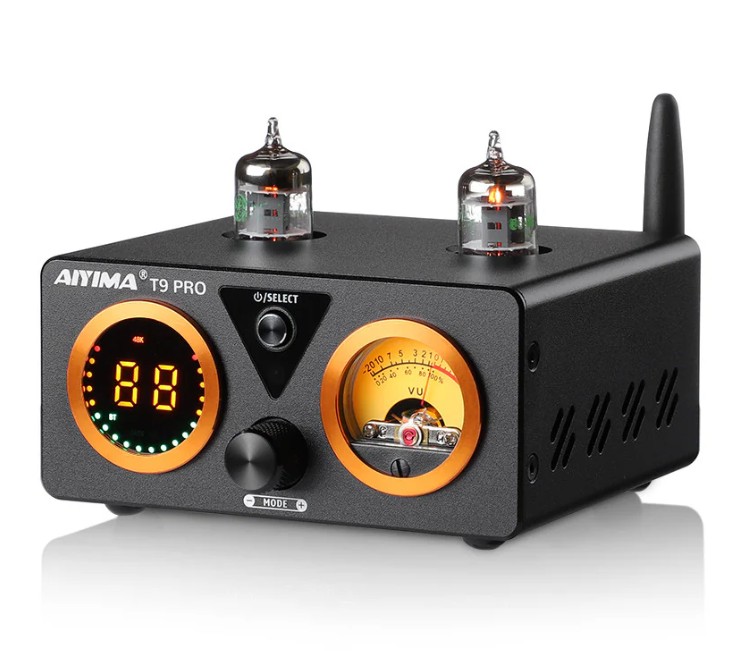
The AIYIMA T9 Pro is a compact hybrid integrated amplifier designed to connect computers, televisions, smartphones and conventional analog sources to a pair of passive speakers.
It combines two JAN5725 vacuum tubes with an ES9018K2M digital-to-analog converter and a TPA3250 Class D speaker-output stage. The tubes participate in the signal path, while the solid-state output stage supplies the power required by passive speakers.
Its main attraction is connectivity. The T9 Pro includes Bluetooth 5.1, USB, optical, coaxial and analog RCA inputs, as well as remote control, bass and treble adjustment and a front VU meter.
The AIYIMA T9 Pro is a practical all-in-one hybrid amplifier for a computer, television or compact living-room system. Its wide input selection and remote control make it more convenient than a basic analog amplifier. However, it has no phono input or headphone output, and its advertised 100 W per channel figure requires context.
Computers, televisions and compact passive-speaker systems
Hybrid tube DAC and Class D integrated amplifier
Bluetooth, USB, optical, coaxial and RCA inputs
No phono stage or headphone output
Check the current AIYIMA T9 Pro price
AIYIMA T9 Pro Specifications
| Product type | Hybrid integrated DAC and passive-speaker amplifier |
|---|---|
| Power-amplifier chip | TPA3250 |
| DAC chip | ES9018K2M |
| Tube model | Two JAN5725 vacuum tubes |
| Replaceable tube families | 6AK5, 6K4, EF95, 6J1, GE5654 and compatible alternatives listed by AIYIMA |
| Inputs | Bluetooth 5.1, USB, optical, coaxial and stereo RCA |
| Outputs | Passive-speaker terminals and analog AUX output |
| USB sample rates | Up to 24-bit / 192 kHz according to AIYIMA |
| Optical and coaxial sample rates | Up to 24-bit / 192 kHz |
| Bluetooth version | Bluetooth 5.1 |
| Bluetooth codecs | SBC, AAC, aptX, aptX Low Latency and aptX HD |
| Speaker impedance | 4-8 ohms according to AIYIMA |
| Advertised maximum output | 100 W + 100 W into 4 ohms |
| Power input | DC 18-32 V, 3 A or more |
| Power-supply options | 24 V and 32 V versions may be offered |
| Published signal-to-noise ratio | At least 102 dB |
| Published frequency response | 20 Hz-20 kHz, ±1.5 dB |
| Published THD | 0.03% at 1 kHz and 1 W |
| Remote control | Yes |
| Headphone output | No |
| Phono input | No |
What Is the AIYIMA T9 Pro?
The T9 Pro combines several audio components in one enclosure:
- Digital-to-analog converter
- Bluetooth receiver
- Analog preamplifier
- Hybrid tube stage
- Class D passive-speaker amplifier
- Remote-controlled input and volume system
It can receive digital audio directly from a computer, television, CD transport or streamer without requiring a separate external DAC.
Passive speakers connect directly to the rear speaker terminals. The analog output can feed active speakers, an external power amplifier or another suitable line-level component.
Is the AIYIMA T9 Pro a Real Tube Amplifier?
The T9 Pro contains two electrically active JAN5725 vacuum tubes, but it is not a traditional all-tube power amplifier.
The tubes operate in the signal-processing stage. A Texas Instruments TPA3250 Class D integrated circuit supplies the power used to drive passive speakers.
It is therefore best described as a hybrid tube amplifier. This architecture allows AIYIMA to combine visible replaceable tubes with compact dimensions, relatively high efficiency and useful speaker output.
Buyers wanting output tubes and large speaker transformers should consider a traditional full-tube amplifier instead.
Design and Controls
The T9 Pro uses a compact metal enclosure with two visible tubes and an illuminated analog-style VU meter on the front.
The front control knob is used for volume and menu operation. The display identifies the selected input and volume level, while the supplied remote allows operation from a listening position.
Available adjustments include:
- Volume
- Input selection
- Bass
- Treble
- Mute
- Power and standby
The VU meter is primarily a visual feature. It should not be treated as calibrated laboratory equipment for measuring speaker power.
USB Input
The USB input allows the T9 Pro to function as an external DAC and amplifier for a Windows, macOS or Linux computer.
AIYIMA specifies USB playback up to 24-bit / 192 kHz. Actual available formats can depend on the operating system, playback software and USB configuration.
Select the T9 Pro as the computer’s audio-output device after connecting the USB cable. Set the computer volume conservatively during initial setup and control the final level with the amplifier.
Optical Input
The optical input is useful for connecting televisions, streamers, game consoles and CD players with a compatible digital output.
When connecting a television, configure its digital output for stereo PCM. Multichannel Dolby or DTS bitstreams may not be decoded by a stereo amplifier.
Optical connections also provide electrical isolation between the source and amplifier, which can sometimes help avoid ground-loop noise.
Coaxial Digital Input
The coaxial input accepts a stereo digital signal from compatible CD transports, streamers and other source components.
Use a suitable 75-ohm digital coaxial cable when possible. A conventional RCA audio cable may work over short distances but is not necessarily designed for digital transmission.
Bluetooth 5.1
Bluetooth provides convenient wireless playback from phones, tablets and computers. AIYIMA lists support for SBC, AAC, aptX, aptX Low Latency and aptX HD.
The source device must support the same codec. The amplifier and phone will automatically negotiate a mutually supported format.
AIYIMA notes that Bluetooth pairing is available only when the amplifier is switched to Bluetooth input mode.
Wireless range and stability can be affected by walls, Wi-Fi routers, antennas and other devices operating in the 2.4 GHz band.
TubeDecoded may earn a commission when you purchase through links on this page. This does not increase the price you pay or determine our editorial conclusions.
Analog RCA Input
The stereo RCA input accepts a conventional line-level signal from an external DAC, CD player, streamer or other analog source.
The RCA input is not a phono input. A turntable requires either:
- A built-in phono preamplifier
- A separate external phono stage
- Another component providing line-level output
Connecting a conventional turntable cartridge directly to the RCA input will normally produce an extremely quiet and incorrectly equalized signal.
Speaker Output
The T9 Pro is intended for nominal 4-8 ohm passive speakers. The best match will depend on more than nominal impedance.
Also consider:
- Speaker sensitivity
- Minimum impedance
- Room size
- Listening distance
- Desired volume
- Selected power supply
Efficient bookshelf speakers in a small or medium room are generally a more realistic match than very insensitive speakers requiring substantial continuous current.
Analog AUX Output
The rear analog output can send a line-level signal to active speakers, a separate power amplifier or another compatible audio component.
AIYIMA publishes an output amplitude of 2 V. Verify how volume control behaves in your selected operating mode before connecting equipment that does not have its own level adjustment.
The analog output is not designed to power a passive subwoofer directly. Any connected active speaker or subwoofer must contain its own amplifier.
Understanding the 100 W + 100 W Claim
AIYIMA advertises up to 100 watts per channel into a 4-ohm load. That figure should not be interpreted as guaranteed continuous stereo output under every condition.
Available power depends on:
- Whether the amplifier uses a 24 V or 32 V adapter
- The current capacity of the power supply
- Speaker impedance
- Permitted distortion
- Cooling and operating temperature
- Whether one or both channels are driven
A 32 V supply generally permits greater maximum output than a 24 V supply, provided it has adequate current capability and is approved for use with the amplifier.
Buyers should not compare the headline 100 W figure directly with independently measured continuous RMS specifications from larger amplifiers.
24 V vs 32 V Power Supply
The official store offers versions with 24 V and 32 V power supplies. The best choice depends on the connected speakers and required listening level.
A 24 V supply may be sufficient for efficient speakers and moderate listening levels. A suitable 32 V supply provides more voltage headroom for higher output.
Never exceed the manufacturer’s maximum input voltage. Also verify:
- Output voltage
- Current capacity
- Connector size
- Connector polarity
- Regional AC plug
AliExpress listings may offer the T9 Pro without a power adapter or with different 24 V and 32 V options. Confirm exactly which adapter is included before ordering.
Tube Configuration and Tube Rolling
The T9 Pro uses two JAN5725 small-signal tubes. AIYIMA lists several possible replacements, including 6AK5, 6K4, EF95, 6J1 and GE5654-family tubes.
Compatible replacement tubes may affect:
- Noise
- Channel balance
- Gain
- Distortion characteristics
- Subjective tonal presentation
Tube rolling does not guarantee better sound. The condition and electrical compatibility of the replacement are more important than price or brand reputation.
AIYIMA specifically warns against changing tubes while the amplifier is powered. Switch it off, disconnect the power adapter and allow the tubes to cool completely.
Expected Sound and Performance
TubeDecoded does not assign a definitive sound signature without controlled listening tests and measurements.
The result will depend on:
- The connected speakers
- The selected input
- The external source
- The power-supply voltage and capacity
- The installed tubes
- The bass and treble settings
- The room and listening position
Descriptions such as warm, smooth or analog are subjective. The presence of tubes does not automatically determine the amplifier’s frequency response or distortion.
Pros and Cons
Advantages
- USB, optical, coaxial, Bluetooth and RCA inputs
- Built-in ES9018K2M DAC
- TPA3250 Class D speaker-output stage
- Two replaceable JAN5725 tubes
- Can power passive speakers
- Analog output for system expansion
- Remote control
- Bass and treble adjustment
- Visual VU meter
- Compact all-in-one design
Limitations
- No headphone output
- No dedicated phono input
- Hybrid rather than traditional all-tube amplification
- Advertised power depends heavily on the power supply
- Power adapter may be optional in some listings
- No balanced input or output
- VU meter is primarily decorative
- Official chipset descriptions have varied between product-page sections
Who Should Buy the AIYIMA T9 Pro?
The T9 Pro is best suited to:
- Desktop systems using passive speakers
- Television systems requiring optical input
- Computer users wanting an integrated USB DAC
- Listeners who use Bluetooth regularly
- Buyers who want one compact component instead of separate devices
- Users interested in experimenting with replaceable small-signal tubes
- Small and medium rooms with reasonably efficient speakers
Who Should Not Buy It?
Consider another amplifier when you need:
- A dedicated headphone output
- A built-in MM or MC phono stage
- A traditional tube power-output circuit
- Balanced audio connections
- Verified high continuous output for difficult speakers
- Multiple analog RCA inputs
- A calibrated power meter
AIYIMA T9 Pro Alternatives
Douk Audio X1
Consider the Douk Audio X1 when an integrated MM phono input is more important than USB, optical and coaxial digital connectivity.
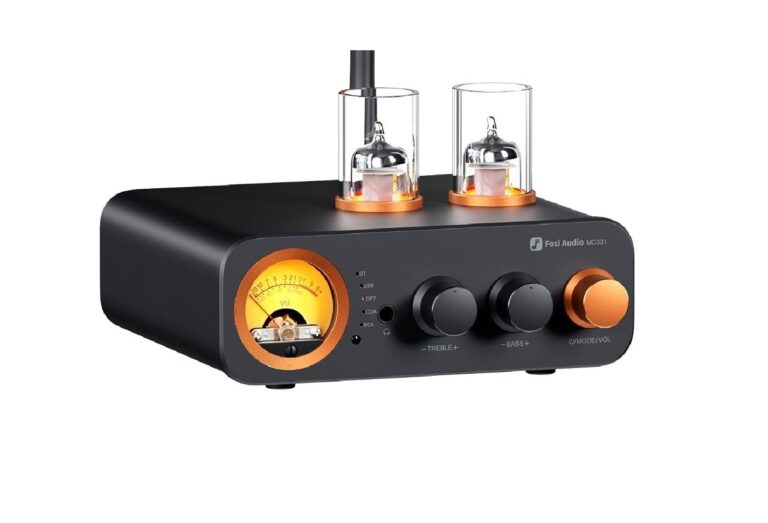
Fosi Audio MC331
Consider the Fosi Audio MC331 when you want similar digital connectivity together with a dedicated headphone output.
xDuoo MT-602
Consider the xDuoo MT-602 when the system is intended exclusively for headphones and you already own a suitable external DAC.
Traditional tube amplifier
Consider a transformer-coupled tube amplifier when power tubes and a conventional tube speaker-output stage are essential requirements.
What to Check Before Ordering
- Confirm that the listing is for the T9 Pro rather than the original T9.
- Check whether a power adapter is included.
- Choose between the available 24 V and 32 V supply options.
- Select the correct regional plug.
- Confirm that two JAN5725 tubes are included.
- Check that the remote control is included.
- Review recent seller ratings and customer photographs.
- Compare the final price including VAT and shipping.
- Remember that the RCA input is not a phono input.
- Remember that the T9 Pro has no headphone output.
- Verify that your passive speakers have a suitable impedance and sensitivity.
Disconnect the amplifier from power and allow the tubes to cool before replacing them. Do not use an adapter with the wrong voltage, connector or polarity.
Frequently Asked Questions
Is the AIYIMA T9 Pro a tube amplifier?
Yes, but it is a hybrid amplifier. Two JAN5725 tubes operate in the signal stage, while a TPA3250 Class D circuit drives the passive speakers.
Does the T9 Pro have a built-in DAC?
Yes. It uses an ES9018K2M DAC and accepts USB, optical and coaxial digital signals.
Can it connect directly to a television?
Yes. The optical input is normally the most convenient connection. Configure the television output for stereo PCM rather than a multichannel bitstream.
Does it have Bluetooth?
Yes. AIYIMA specifies Bluetooth 5.1 with SBC, AAC, aptX, aptX Low Latency and aptX HD support.
Does it have a headphone output?
No. A separate headphone amplifier is required for private listening.
Can I connect a turntable directly?
Only when the turntable has a built-in phono preamplifier. Otherwise, a separate MM or MC phono stage is required.
Does it really produce 100 watts per channel?
AIYIMA advertises up to 100 W per channel into 4 ohms. Actual output depends on the power supply, speaker impedance, distortion limit and test conditions.
Should I choose the 24 V or 32 V version?
The 32 V option generally provides more output headroom. The 24 V version may be sufficient for efficient speakers and moderate listening levels.
Can the tubes be replaced?
Yes. AIYIMA lists JAN5725 together with compatible 6AK5, 6K4, EF95, 6J1 and GE5654-family alternatives.
Can it power a passive subwoofer?
No. The analog output can feed compatible active equipment, but a passive subwoofer requires a separate power amplifier.
Final Verdict
The AIYIMA T9 Pro offers a useful combination of digital connectivity, passive-speaker amplification, replaceable tubes and remote operation.
It is particularly attractive for users who want to connect a television, computer and smartphone without purchasing a separate DAC, Bluetooth receiver and amplifier.
Its limitations are important. It does not include a headphone output or phono stage, and it should not be confused with a traditional all-tube speaker amplifier. The maximum power claim also depends strongly on the selected adapter.
Recommended for buyers seeking a compact hybrid amplifier with USB, optical, coaxial, Bluetooth and passive-speaker output. Less suitable for turntable users without an external phono stage, headphone listeners or buyers seeking a traditional tube power-output design.