Douk Audio X1 Review
This is a research-based review using manufacturer documentation, published specifications and product-listing analysis. We have not physically tested this amplifier unless this page is later updated to state otherwise.
The Douk Audio X1 is a compact hybrid integrated amplifier designed for buyers who want to connect passive speakers, Bluetooth devices and an MM turntable without assembling several separate components.
It combines two replaceable small-signal tubes with a TDA7498E Class D speaker-output stage. This means the X1 is not a traditional all-tube power amplifier. The tubes work in the signal path, while solid-state electronics provide the power required by passive speakers.
Its strongest features are the integrated MM phono input, Bluetooth with aptX support, bass and treble controls, and a dedicated low-frequency output for an active subwoofer. Its main limitation is the absence of USB, optical and coaxial digital inputs.
The Douk Audio X1 is an attractive choice for a compact and affordable 2.1-channel system using passive speakers, Bluetooth and an MM turntable. It is versatile and beginner-friendly, but buyers should understand its hybrid architecture and treat its advertised 160 W per channel figure as a maximum chip-level claim rather than realistic continuous output from the supplied power adapter.
Compact stereo systems, MM turntables and passive bookshelf speakers
Hybrid tube and Class D integrated amplifier
Bluetooth, phono and speaker amplification in one small unit
No USB, optical, coaxial or headphone output
Check the current Douk Audio X1 price
Douk Audio X1 Specifications
| Product type | Hybrid integrated speaker amplifier |
|---|---|
| Amplifier chip | TDA7498E Class D amplifier |
| Operational amplifier | NE5532 |
| Tube configuration | Two replaceable small-signal vacuum tubes |
| Published tube references | JAN5725 and JAN5654 are both mentioned in official product information |
| Inputs | Bluetooth 5.0, stereo RCA and MM phono |
| Outputs | Passive-speaker terminals and low-frequency output for an active subwoofer |
| Bluetooth chip | QCC3034 |
| Bluetooth codecs | aptX and aptX HD |
| Speaker impedance | 4-8 ohms according to the manufacturer |
| Advertised maximum power | 160 W + 160 W into 4 ohms |
| Included power supply | 32 V / 5 A |
| Permitted DC input | 19-35 V |
| Frequency response | 20 Hz-20 kHz, ±3 dB according to the manufacturer |
| Signal-to-noise ratio | Greater than 90 dB according to the manufacturer |
| Published THD | 0.5% |
| Tone control range | ±6 dB |
| Dimensions | 115 × 166 × 60 mm |
| Net weight | Approximately 782 g |
| Headphone output | No |
| Remote control | No |
Is the Douk Audio X1 a Real Tube Amplifier?
The Douk Audio X1 contains electrically active vacuum tubes, but it is more accurately described as a hybrid tube amplifier.
The tubes participate in the signal-processing or preamplifier section. A TDA7498E Class D integrated circuit provides the final power used to drive passive speakers.
This is different from a traditional tube power amplifier, where output tubes and large output transformers provide the speaker-driving power.
Calling the X1 hybrid is not criticism. Hybrid construction allows it to remain compact, relatively efficient and affordable while still providing replaceable tubes and enough output capability for many small stereo systems.
Design and Build
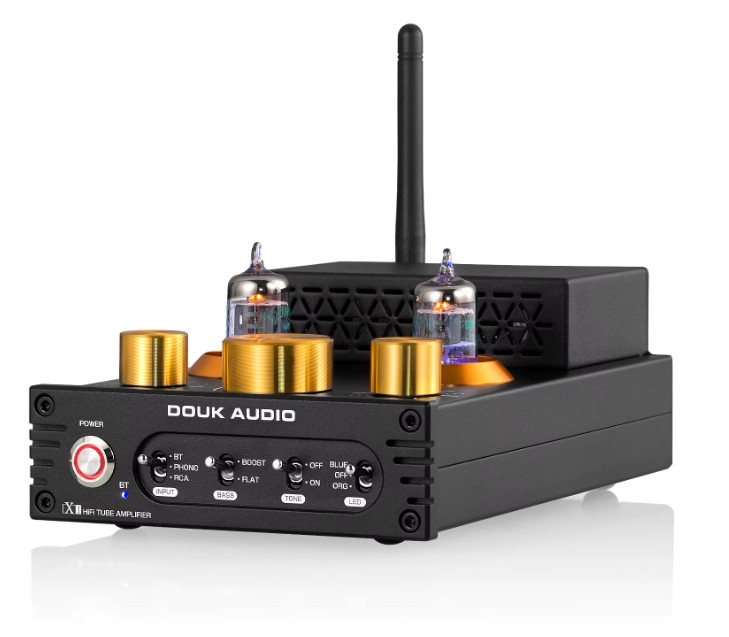
The X1 uses a compact aluminum enclosure with two visible tubes mounted on the top panel. Controls and toggle switches are placed on the front, while the inputs, speaker terminals, subwoofer output, Bluetooth antenna and power connection are located at the rear.
The front controls include:
- Volume adjustment
- Bass adjustment
- Treble adjustment
- Input selection
- Optional bass enhancement
- Tone-control bypass
- Tube-light control
Tone bypass is a useful addition for listeners who prefer the shortest available signal path. The bass-enhancement switch may be useful with small speakers, although excessive boost can increase distortion or place additional demands on the speakers.
Inputs and Outputs
Bluetooth 5.0
Bluetooth is handled by a QCC3034 receiver supporting aptX and aptX HD. This makes the X1 convenient for casual playback from smartphones, tablets and compatible computers.
Bluetooth remains a compressed or processed wireless connection and is not automatically superior to a good wired source. Its primary advantage is convenience.
Stereo RCA input
The conventional RCA input accepts a line-level signal from devices such as a DAC, CD player, streamer, television converter or external phono stage.
MM phono input
The integrated phono stage is intended for turntables fitted with a compatible moving-magnet cartridge. A grounding terminal is provided to help reduce hum.
Buyers using a moving-coil cartridge should not assume compatibility. Most low-output MC cartridges require a different gain structure or an external step-up device.
Passive-speaker output
The X1 provides binding posts for compatible 4-8 ohm passive speakers. It is best matched with reasonably efficient bookshelf or compact floorstanding speakers in a small or medium-sized room.
Active-subwoofer output
The low-frequency output allows connection to a powered subwoofer. The subwoofer must contain its own amplifier. A passive subwoofer cannot be connected directly to this output.
No headphone output
The X1 does not provide a dedicated headphone connection. Buyers who need headphones should consider a separate headphone amplifier or a different all-in-one product.
Understanding the 160 W + 160 W Claim
Douk Audio advertises maximum output of 160 watts per channel into 4 ohms. That figure is associated with the maximum capability claimed for the TDA7498E amplifier circuit under selected operating conditions.
The supplied 32 V / 5 A adapter can provide approximately 160 watts of DC input power before amplifier losses. It therefore cannot support 320 watts of continuous audio output.
The advertised figure should be treated as a maximum or chip-level specification rather than a realistic continuous rating with the included adapter.
This does not mean the X1 lacks useful power. It means buyers should avoid comparing its headline wattage directly with independently measured continuous RMS ratings from larger amplifiers.
Tube Configuration and Tube Rolling
The X1 uses two replaceable small-signal tubes. The sockets allow experimentation with compatible alternatives, commonly called tube rolling.
Official Douk Audio product information currently refers to both JAN5725 and JAN5654 tubes in different parts of the same product page. AliExpress listings may also show different included tubes. Confirm the exact tube model with the seller before purchasing replacements.
Never install a tube only because it has the same physical size or fits the socket. Similar-looking tubes can use different pin assignments, heater requirements or electrical characteristics.
Before changing the tubes:
- Turn the amplifier off.
- Disconnect the power supply.
- Allow the tubes to cool completely.
- Verify the supported replacement family.
- Insert the new tube without forcing the pins.
Expected Sound and Performance
Without controlled listening tests and measurements, TubeDecoded does not assign a definitive sound signature to the X1.
The final result will depend on:
- The connected speakers
- The listening distance and room
- The selected input
- The phono cartridge or external source
- The tone-control settings
- The installed tubes
- The quality and voltage of the power supply
Buyers should be cautious with descriptions such as warm, sweet or analog. These terms are subjective and do not replace measurements of frequency response, noise, distortion and output capability.
Turntable Performance
The integrated MM phono input is one of the X1’s strongest selling points. It removes the need to purchase a separate entry-level phono preamplifier when using a compatible moving-magnet cartridge.
A successful turntable setup requires:
- A compatible MM cartridge
- Correct connection to the phono input
- Connection of the grounding wire when required
- Placement away from noisy power adapters and wireless equipment
- Appropriate speaker positioning
If excessive hum occurs, check the ground wire, RCA cables, turntable power supply and physical distance from other electronic devices.
Bluetooth Performance
The supported aptX and aptX HD codecs can provide better Bluetooth quality than the basic SBC codec when the transmitting device also supports them.
Codec support does not guarantee identical performance from every source. Phones, computers and operating systems may select different codecs automatically.
Bluetooth is appropriate for convenient everyday playback. Buyers seeking the most consistent connection should use the wired RCA input with a suitable DAC or streamer.
Speaker Matching
Douk Audio specifies compatibility with nominal 4-8 ohm speakers. Impedance alone does not determine whether a speaker is easy to drive.
Also consider:
- Speaker sensitivity
- Minimum impedance
- Listening distance
- Room size
- Desired volume
- Amount of bass boost
Efficient bookshelf speakers are generally a safer match than insensitive speakers requiring substantial continuous current.
Pros and Cons
Advantages
- Compact integrated amplifier
- Can power passive speakers
- Built-in MM phono stage
- Bluetooth with aptX and aptX HD
- Output for an active subwoofer
- Replaceable tubes
- Bass and treble controls
- Tone-control bypass
- Suitable for a simple 2.1-channel system
Limitations
- Hybrid rather than traditional all-tube amplification
- No USB input
- No optical or coaxial digital input
- No headphone output
- No remote control
- Advertised maximum wattage is potentially misleading
- Official tube information is inconsistent
- Phono input is intended primarily for MM cartridges
Who Should Buy the Douk Audio X1?
The X1 is a strong candidate for:
- Beginners building their first compact stereo system
- Turntable owners using a compatible MM cartridge
- Users who want Bluetooth and passive-speaker output
- Small-room and desktop systems
- Buyers planning a compact 2.1 system with an active subwoofer
- Users interested in basic tube rolling
Who Should Not Buy It?
Consider another amplifier when you need:
- A traditional tube power-output stage
- A built-in USB DAC
- Optical or coaxial television input
- A dedicated headphone output
- Remote volume control
- Verified high continuous power for difficult speakers
- Support for a low-output moving-coil cartridge
Alternatives to the Douk Audio X1
AIYIMA T9 Pro
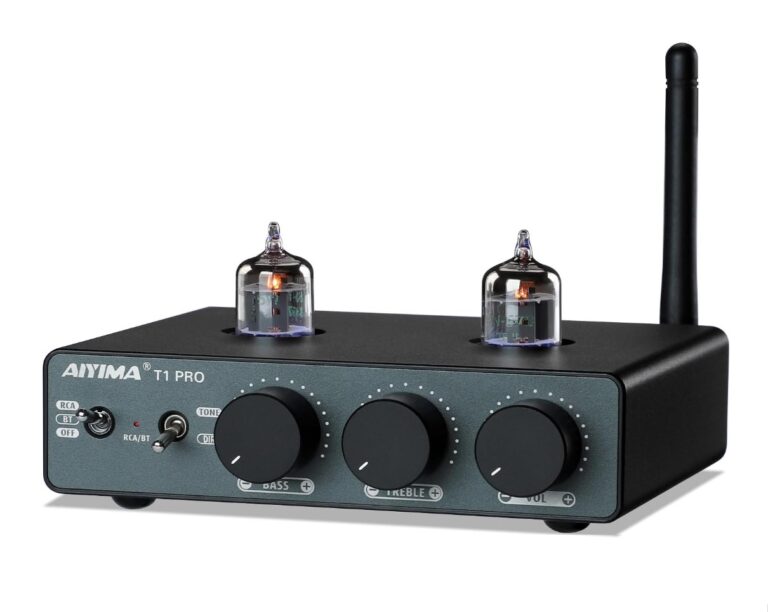
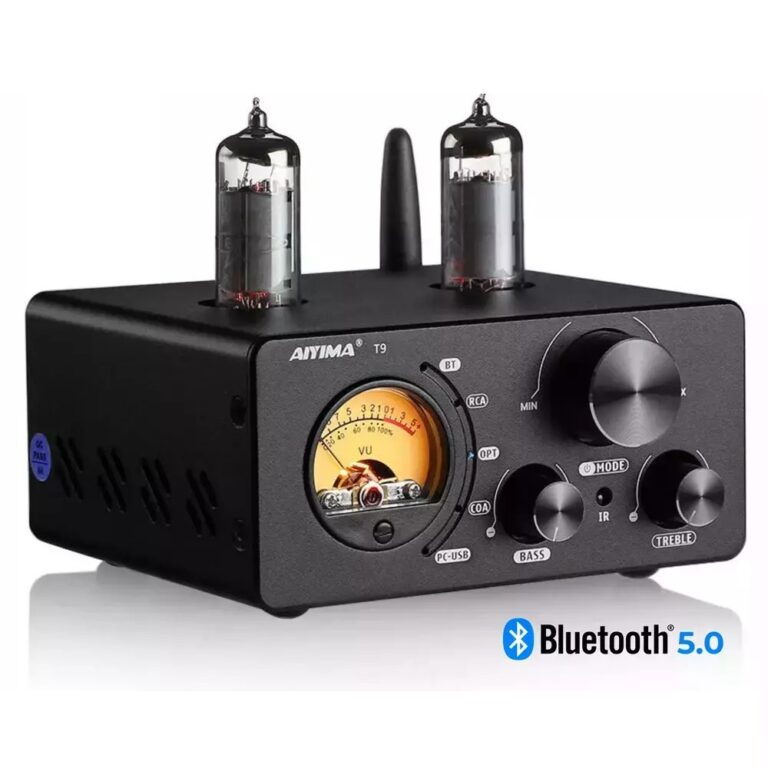
Consider the AIYIMA T9 Pro when USB, optical and coaxial digital inputs are more important than an integrated phono stage.
Fosi Audio MC331
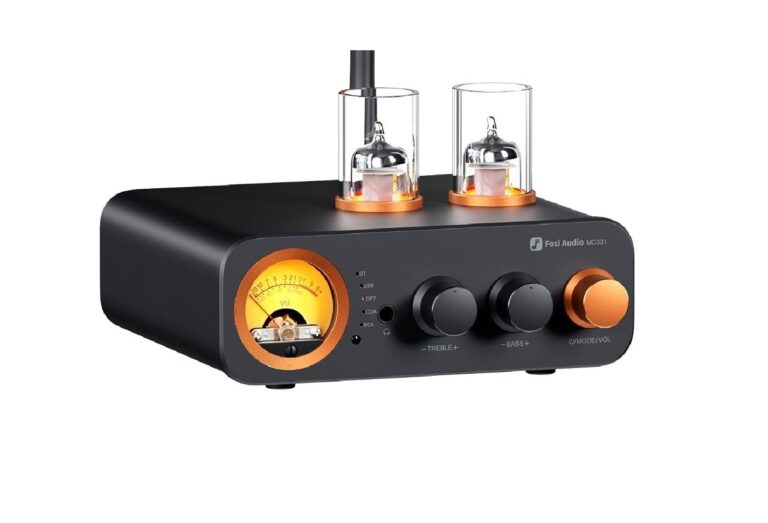
Consider the Fosi Audio MC331 when you need digital inputs, remote control and a headphone connection in the same compact system.
Traditional tube amplifier
Consider a larger transformer-coupled amplifier when the objective is a genuine tube power-output stage rather than a compact hybrid Class D design.
What to Check Before Ordering from AliExpress
- Confirm that the listing is for the Douk Audio X1 and not a visually similar model.
- Check whether the 32 V / 5 A power supply is included.
- Select the correct regional plug.
- Ask whether JAN5725 or JAN5654 tubes are included.
- Confirm that the product supports your local input-voltage arrangement through its supplied adapter.
- Check recent seller reviews and customer photographs.
- Compare total cost including VAT, shipping and import charges.
- Read the seller’s warranty and return conditions.
- Verify that your turntable uses a compatible MM cartridge.
- Remember that the subwoofer output requires an active subwoofer.
Disconnect the amplifier from power before changing tubes. Allow the tubes to cool. Do not open or modify electronic equipment unless you understand the risks associated with internal voltages and charged capacitors.
Frequently Asked Questions
Is the Douk Audio X1 fully tube-based?
No. It is a hybrid amplifier. The tubes operate in the signal stage, while a TDA7498E Class D circuit provides the speaker-output power.
Can the Douk Audio X1 power passive speakers?
Yes. It includes speaker terminals and is specified for nominal 4-8 ohm speakers. Actual suitability also depends on speaker sensitivity, minimum impedance and required listening volume.
Does the Douk Audio X1 have a headphone output?
No. It is designed primarily for passive speakers and an active subwoofer.
Can I connect a turntable directly?
Yes, when the turntable uses a compatible MM cartridge. A low-output MC cartridge may require additional equipment.
Can it power a passive subwoofer?
No. The low-frequency output is intended for an active subwoofer with its own built-in amplifier.
Does it really produce 160 watts per channel?
Douk Audio publishes 160 W + 160 W as a maximum figure into 4 ohms. The supplied 32 V / 5 A adapter cannot deliver that amount as continuous stereo output. The claim should not be interpreted as a continuous RMS rating with the included supply.
Which tubes does the Douk Audio X1 use?
Official product information currently contains references to both JAN5725 and JAN5654. Confirm the included tube model with the seller before ordering replacements.
Does it support aptX HD?
The manufacturer specifies a QCC3034 Bluetooth receiver with aptX and aptX HD support. The transmitting device must also support the selected codec.
Is the Douk Audio X1 good for beginners?
Yes. It combines Bluetooth, MM phono amplification and passive-speaker output in one compact device. Buyers still need to verify speaker compatibility and understand that it is a hybrid design.
Final Verdict
The Douk Audio X1 offers an unusually useful combination of functions for a compact amplifier. Its Bluetooth receiver, MM phono stage, passive-speaker output and active subwoofer connection make it well suited to an affordable desktop or small-room system.
Its limitations are equally clear. It has no digital inputs, headphone output or remote control, and it is not a traditional all-tube power amplifier. The published 160 W per channel claim also requires significant context.
Buyers who understand those limitations may find the X1 to be a practical and flexible introduction to hybrid tube audio.
Recommended for buyers who want a compact hybrid amplifier for passive speakers, Bluetooth and an MM turntable. Not recommended for users seeking a traditional transformer-coupled tube amplifier or an all-in-one digital and headphone system.