AIYIMA T20 Review: A Serious Balanced Tube Preamplifier?
Quick verdict: The AIYIMA T20 is a line-level preamplifier for users who already own a power amplifier or active speakers. Its main attractions are balanced XLR connectivity, RCA compatibility, two ECC83/12AX7-family tubes, a remote-controlled volume stage and 12 V trigger outputs. It does not power passive speakers and has no built-in DAC, phono stage or headphone output.
This AIYIMA T20 review is an independent, research-based assessment of the product’s published specifications, system role and practical buying considerations. It is not presented as a laboratory measurement or a claim of hands-on listening.
What Is the AIYIMA T20?
The T20 represents a more ambitious approach than the small Bluetooth tube buffers commonly sold for desktop systems. AIYIMA describes it as a fully balanced preamplifier and equips it with balanced XLR inputs and outputs as well as conventional RCA connections. This makes it relevant to systems built around balanced DACs, power amplifiers or active monitors.
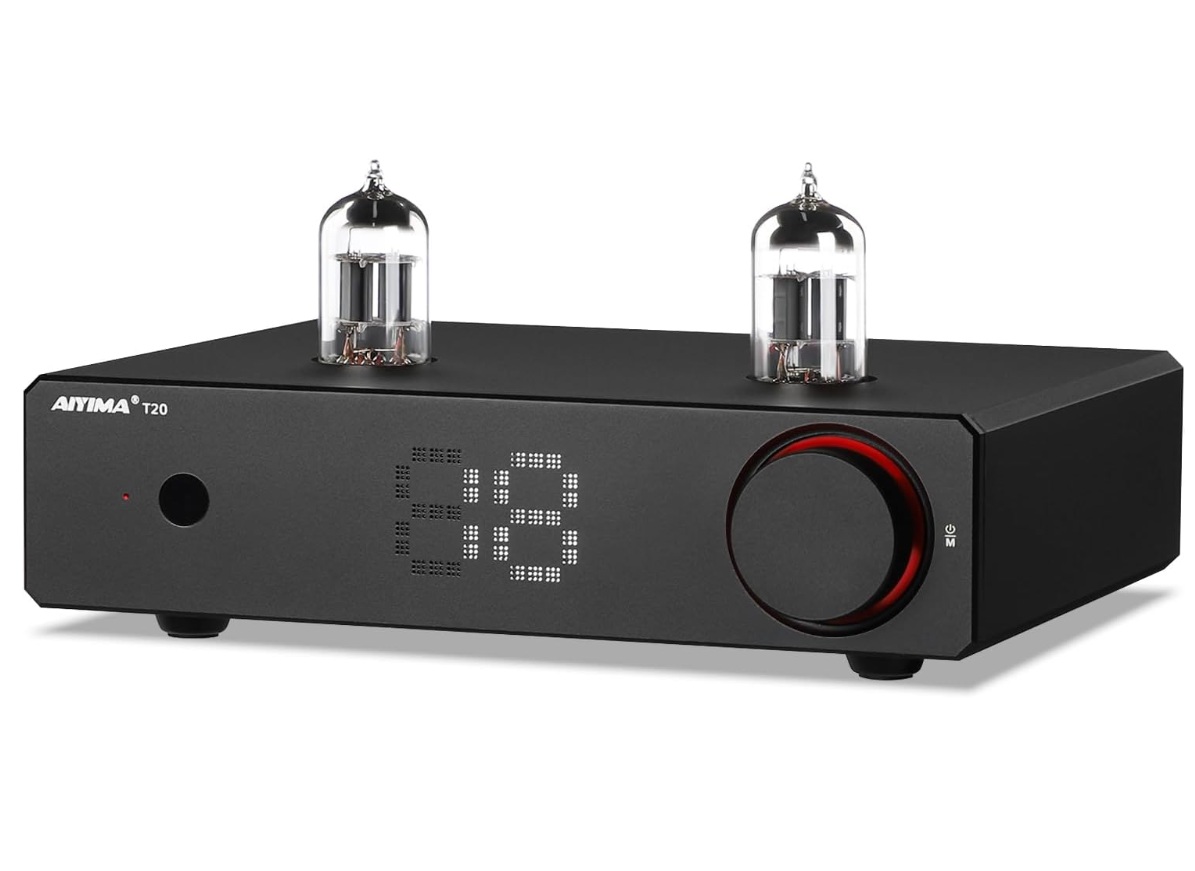
Two ECC83-family tubes are visible on the top panel. AIYIMA states that the tube section is supplied at up to 180 V, which is substantially different from decorative low-voltage tube products. The design also uses LME49720 operational amplifiers, and the manufacturer shows at least one socketed op-amp position for compatible replacement.
The large front display, remote control and trigger outputs make the T20 easier to integrate into a modern system than a minimalist passive preamp. Those conveniences are central to its value proposition.
Key Specifications
| Product type | Balanced line-level tube preamplifier |
|---|---|
| Analog inputs | Balanced XLR and unbalanced RCA |
| Analog outputs | Balanced XLR and unbalanced RCA |
| Tubes | Two ECC83 / 12AX7-family valves |
| Compatible tube families listed | 12AX7-S, 12AX7B, 7025 and 12AX7 |
| Op-amp | LME49720 |
| Published frequency response | 20 Hz-20 kHz, ±0.2 dB |
| Published SNR | ≥112 dB |
| Published THD+N | 0.003% |
| Published noise floor | 20 µV |
| Published dynamic range | 109 dB |
| Tube supply claim | Up to 180 V |
| System control | Remote control and two 12 V trigger outputs |
| External power supply | 12 V / 2 A |
Specification note: Published power, noise and distortion figures are manufacturer data. They may use different test conditions from independent laboratory measurements and should be compared cautiously.
Design and Build
The T20 is larger and more system-oriented than pocket-size tube preamps. A central dot-matrix display shows volume and operating status, while the large multifunction knob controls power, input selection, mute and volume. The black enclosure and exposed valves give it a modern rather than traditionally vintage appearance. Leave ventilation space above the tubes and avoid touching them during operation.
Inputs, Outputs and System Compatibility
The rear panel provides XLR and RCA inputs plus matching XLR and RCA outputs. Balanced connections are useful for long cable runs and systems where ground noise is a problem, but they do not guarantee better sound by themselves. The T20 also provides two 12 V trigger outputs intended to switch companion equipment. There are no digital inputs, Bluetooth, turntable phono input, speaker terminals or headphone jacks.
Affiliate disclosure: TubeDecoded may earn a commission from qualifying purchases made through links in this article. This does not increase the price you pay or determine our conclusions.
How Important Is the Tube Stage?
AIYIMA identifies the valves as ECC83 and lists common 12AX7-family substitutes. This is a widely available tube family with many current-production and vintage options. Tube replacement should be performed only after the unit is switched off, disconnected and allowed to cool. Matched pairs may help maintain consistent channel behavior, although the exact circuit topology determines how critical matching is.
What Should It Sound Like?
The official figures indicate a wide, flat line-level response and low measured noise for a tube-equipped preamplifier. Those numbers are manufacturer claims rather than independent laboratory results, but they position the T20 as a controlled, modern preamp rather than a deliberately high-distortion effect box. The actual system result will depend on the power amplifier input sensitivity, source output level, speakers and chosen tubes.
AIYIMA T20 Pros and Cons
Advantages
- Balanced XLR input and output
- RCA input and output for conventional systems
- High-voltage ECC83/12AX7-family tube stage
- Remote-controlled volume and input selection
- 12 V trigger integration
- Strong published noise and distortion specifications
Limitations
- No DAC, Bluetooth or network streaming
- No phono stage
- No headphone output
- Requires a separate power amplifier or active speakers
- Balanced topology adds little value when the rest of the system is RCA only
Recommended Setup
- Connect sources to either RCA or XLR inputs, avoiding unnecessary adapters.
- Connect the outputs to an active speaker or power amplifier with its gain reduced.
- Use the 12 V trigger only with equipment designed for compatible trigger voltage.
- Keep sufficient space above the ECC83 tubes for ventilation.
- Start with the volume low after changing inputs or tubes.
- Do not hot-swap tubes. Disconnect power and allow the valves to cool first.
Who Should Buy It?
The T20 is aimed at listeners building a separates system around a DAC, streamer or analog source and a dedicated power amplifier. It is especially appealing when balanced connectivity and remote volume control are priorities. It is excessive for a simple desktop system and unsuitable for buyers who need an all-in-one speaker amplifier.
Alternatives to Consider
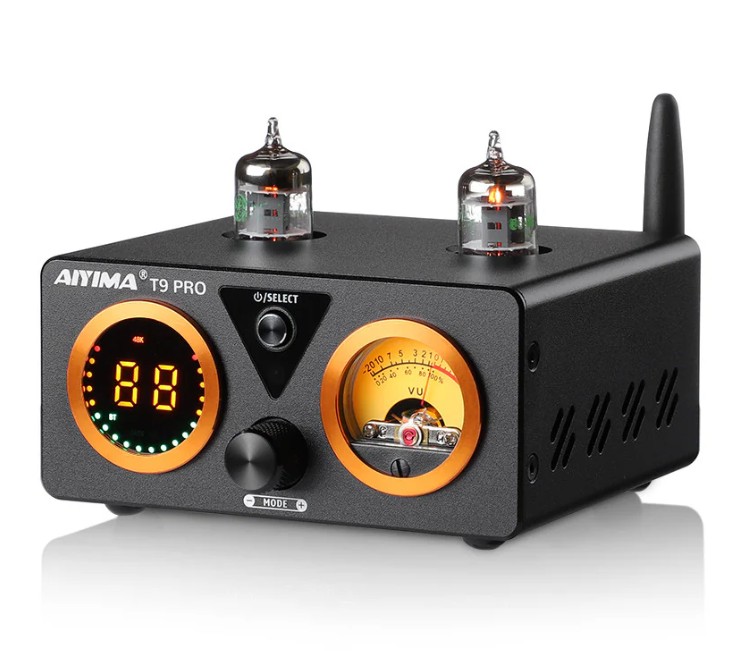
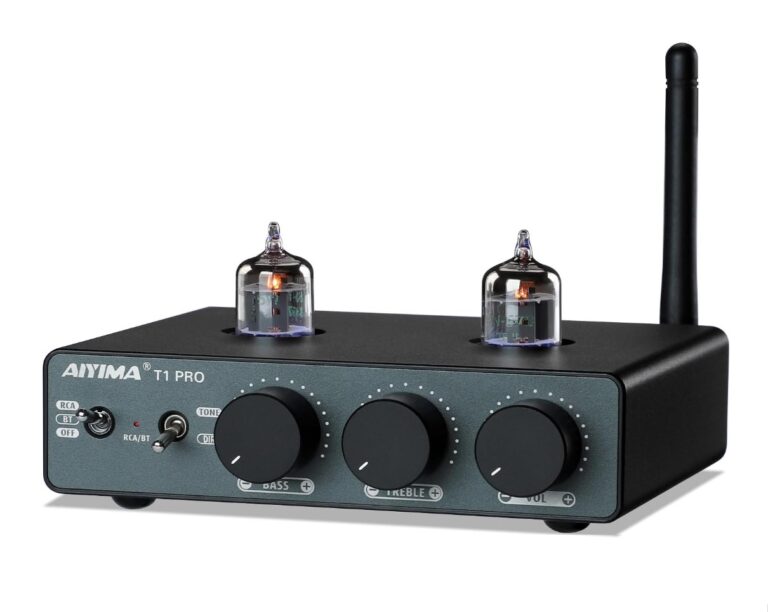
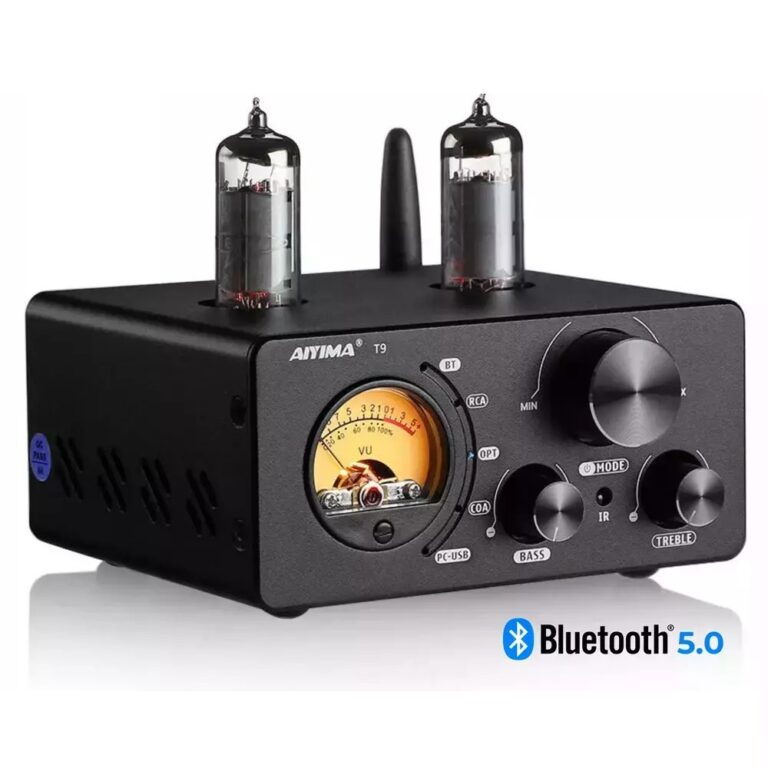
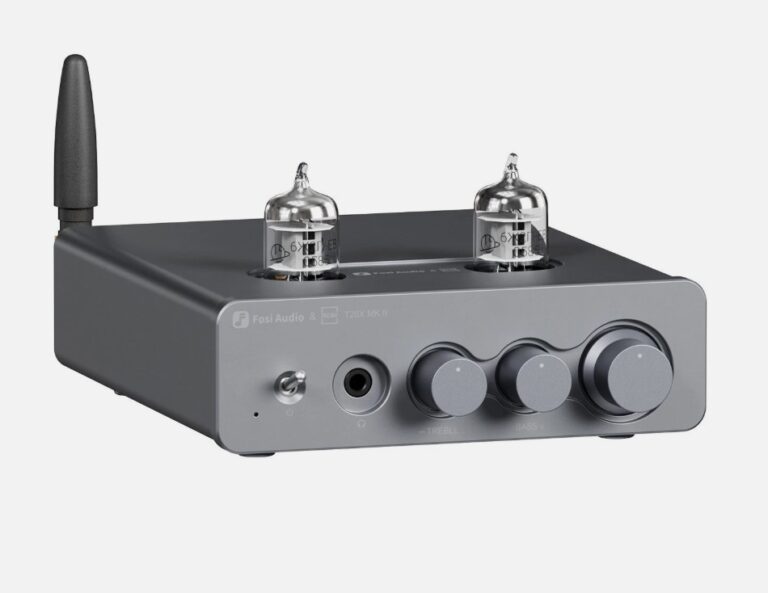
The AIYIMA T1 Pro is cheaper and adds Bluetooth but lacks balanced connections and the T20’s more substantial high-voltage design. The Fosi Audio P3 is a compact alternative with a headphone output. Users who need speaker power, DAC inputs and remote control should look at an integrated model such as the Fosi MC331 or AIYIMA T9 Pro instead.
Frequently Asked Questions
Can the AIYIMA T20 drive passive speakers?
No. It is a preamplifier and requires a separate power amplifier or active speakers.
Does it include a DAC or Bluetooth?
No. Its inputs are analog XLR and RCA.
Are the XLR connections genuinely useful?
They can reduce noise over long runs and integrate well with balanced equipment. The benefit is smaller in an entirely short-cable RCA system.
Which tubes can replace the originals?
AIYIMA lists ECC83/12AX7-family options including 12AX7-S, 12AX7B and 7025. Confirm pin compatibility and operating suitability before installation.
What do the trigger outputs do?
They can send a control signal to compatible equipment so that associated components power on or off together.
Final Verdict
TubeDecoded conclusion: The AIYIMA T20 is one of the more credible modern tube preamps in its price class because it combines balanced analog connectivity, a high-voltage ECC83 stage and proper system-control features. It is a strong fit for separates, but its analog-only design means buyers must already have the required DAC, phono stage and power amplifier.