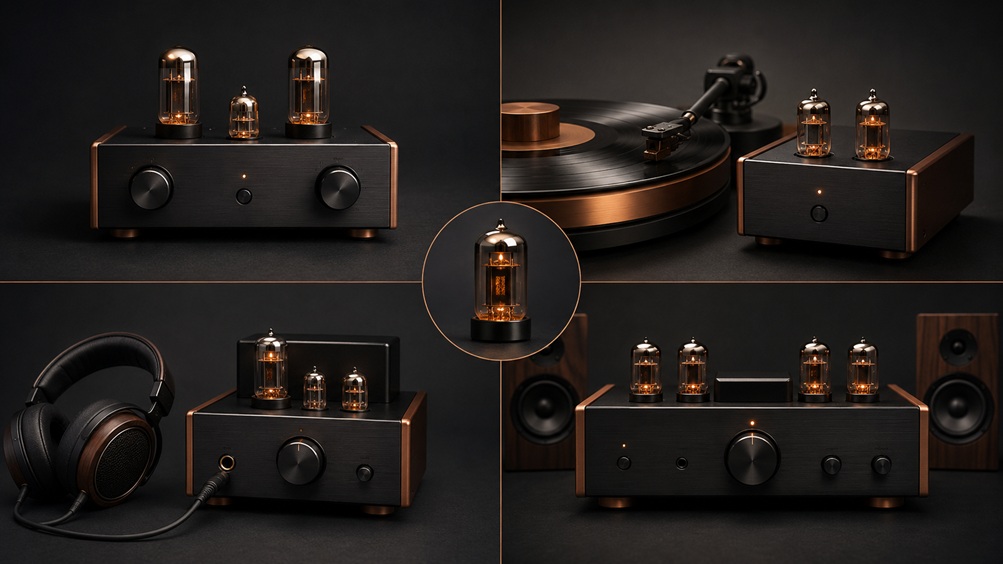
What Type of Tube Amplifier Do You Need? Preamps, Phono Amps and More
Quick answer: Choose a tube line preamplifier when you already own a power amplifier or active speakers, a tube phono preamplifier for a turntable without a line-level output, a tube headphone amplifier for headphones, and a tube integrated amplifier when you want one unit that can drive passive speakers. Always check whether the product is fully tube-based or a hybrid that uses solid-state or Class D power amplification.
This guide explains the main types of tube amplifiers and tube audio devices. It does not use words such as “preamp” or “amplifier” as generic labels. Every category refers specifically to equipment that uses vacuum tubes somewhere in the signal path.
That distinction matters because affordable products sold on AliExpress can look similar while performing completely different jobs. A small tube preamplifier may control volume but cannot drive passive speakers. A tube phono stage may work perfectly with a record player but cannot replace a speaker amplifier. A hybrid integrated amplifier may show two glowing tubes while its actual speaker power comes from a Class D chip.
First: Fully Tube, Hybrid Tube or Tube Buffer?
Before choosing the function of the device, identify how the valves are used. The presence of visible tubes is not enough to prove that an amplifier is fully tube-powered.
Fully tube amplifier
A fully tube amplifier uses vacuum tubes for the major voltage-gain and power-amplification stages. A traditional speaker amplifier normally also uses output transformers to match the power tubes to the loudspeakers. Common output tubes include EL34, 6L6, KT88 and EL84.
The Juson Audio JTA100 is a clear example: its published architecture uses power tubes in a push-pull output stage and separate small-signal tubes for voltage amplification and driving. This is fundamentally different from a compact hybrid amplifier whose speaker output is produced by a semiconductor chip.
Hybrid tube amplifier
A hybrid tube amplifier combines tubes with semiconductors. The valves may be used as a preamplifier, voltage-gain stage or buffer, while transistors or a Class D module provide the current needed by speakers or headphones. Hybrid designs are common in affordable desktop audio because they are compact, efficient and less expensive than a traditional transformer-coupled tube power amplifier.
Examples include the AIYIMA T9 Pro, Douk Audio X1 and Fosi Audio MC331. These products genuinely contain valves, but they should not be described as fully tube-powered speaker amplifiers.
Tube buffer
A tube buffer is placed between a source and another amplifier. It may provide impedance matching, modest gain or tonal shaping, but it normally cannot drive passive speakers. Some inexpensive products advertised as “tube preamps” function primarily as buffers. The practical test is simple: inspect the outputs. If the device offers only RCA line output and no speaker terminals, it still needs active speakers or a separate power amplifier.
Important: A glowing tube is evidence that a tube is present, not evidence that the complete amplifier is tube-powered.
The Basic Tube Audio Signal Chain
A complete system can contain several separate devices. Not every installation needs every stage, because an integrated amplifier or DAC/amplifier may combine multiple functions.
Digital source or streamer
↓
DAC
↓
Tube line preamplifier
↓
Tube or solid-state power amplifier
↓
Passive speakers
A vinyl system adds a phono stage before the line preamplifier:
Turntable and cartridge
↓
Tube phono preamplifier
↓
Tube line preamplifier or integrated amplifier
↓
Power stage
↓
Passive speakers
Tube Amplifier Types at a Glance
| Tube device type | Primary job | What it still needs |
|---|---|---|
| Tube line preamplifier | Controls volume and line-level sources | Power amplifier or active speakers |
| Tube power amplifier | Provides speaker-driving power through a tube output stage | A source with volume control or a preamplifier |
| Tube integrated amplifier | Combines preamplifier and tube power amplifier | Passive speakers and a source |
| Hybrid tube integrated amplifier | Combines a tube stage with solid-state or Class D speaker power | Passive speakers and a source |
| Tube phono preamplifier | Amplifies and equalizes a turntable cartridge signal | Line preamp, integrated amp, active speakers or power amp |
| Tube headphone amplifier | Drives headphones and may also provide line pre-out | Headphones and an analog or digital source |
| Tube DAC/amplifier | Adds digital conversion plus a tube audio stage | Depends on whether it drives headphones, speakers or line output |
| Tube buffer | Adds a valve stage to an existing line-level system | Another amplifier or active speakers |
1. Tube Line Preamplifier
A tube line preamplifier accepts line-level sources such as a DAC, CD player, streamer, television audio output or phone connected through a suitable adapter. It may select between sources, control volume, add tone controls and feed a separate power amplifier or active speakers.
It does not normally accept the raw signal from a turntable cartridge unless it includes a dedicated phono input. It also does not normally power passive speakers. A listing with RCA input and RCA output but no speaker binding posts should be treated as a line-level device.
Typical connection:
Streamer or DAC → Tube line preamplifier → Power amplifier → Passive speakers
AliExpress examples
AIYIMA T1 Pro – tube line preamplifier. It combines analog line input, Bluetooth, volume and tone control, and a subwoofer output. It is suitable for feeding active speakers or a separate power amplifier. It does not replace a speaker power amplifier.
Fosi Audio P3 – tube line preamplifier and headphone amplifier. It is useful when the same desktop system needs line-level control and a headphone output. Read our Fosi Audio P3 review for the full system explanation.
Douk Audio P1 – tube preamplifier, USB DAC and headphone amplifier. This is a more multifunctional choice for users who want Bluetooth or USB audio as well as a tube line stage. It still needs active speakers or a speaker power amplifier.
2. Tube Power Amplifier
A tube power amplifier is responsible for producing enough voltage and current to drive passive loudspeakers. In a traditional design, output tubes feed output transformers, which then connect to the speaker terminals.
A pure power amplifier may have no source selector and may offer limited or no volume control. It expects a preamplifier, DAC with variable output or another source that can safely control level. Connecting a fixed full-volume source directly can produce dangerously high playback levels.
Typical connection:
DAC or streamer → Tube line preamplifier → Tube power amplifier → Passive speakers
AliExpress examples
PA2 EL34 – fully tube, single-ended Class AB speaker amplifier. It is conceptually different from Class D hybrids because the tube stage is intended to provide speaker power. As with any low-powered single-ended amplifier, speaker sensitivity and room size matter.
Juson Audio JTA200 – fully tube integrated/power amplifier. The amp can operate as an integrated amplifier, but it is also relevant here because its power stage uses 4JC6*2+EL34 *2+6H2(5726) *2 tubes.
Buying warning: Do not confuse an inexpensive “tube power amplifier” listing with a hybrid Class D amplifier. Look for the output-tube types, output transformers, speaker impedance taps and realistic power ratings.
3. Hybrid Tube Integrated Amplifier
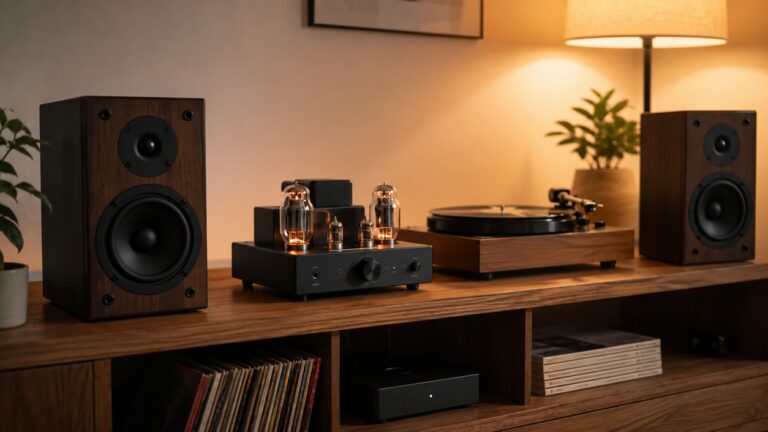
A hybrid tube integrated amplifier combines a tube stage with a semiconductor speaker-power stage. It can drive passive speakers, but the tubes are not normally responsible for the final high-power output. This is the most common “tube amplifier” format among compact AliExpress products.
The design can be practical and good value. The problem is not that it is hybrid; the problem is when a listing creates the impression of an all-tube amplifier without explaining the Class D or transistor output stage.
Typical connection:
Phone, computer, television or turntable with suitable output → Hybrid tube integrated amplifier → Passive speakers
AliExpress examples
AIYIMA T9 Pro – hybrid tube integrated amplifier with DAC. It combines digital and analog inputs, a tube signal stage and semiconductor speaker amplification. It is useful for compact systems that need USB, optical, coaxial or Bluetooth connectivity.
Fosi Audio MC331 – hybrid tube integrated DAC/amplifier. It integrates digital conversion, source selection, headphone output, pre-out and a speaker amplifier. The tubes are part of a hybrid architecture rather than a traditional tube output stage.
Douk Audio X1 – hybrid tube integrated amplifier with MM phono input. It uses tubes in the signal path and a TDA7498E semiconductor power stage for the speakers. The phono input makes it especially convenient for a compact vinyl system.
Affiliate disclosure: TubeDecoded may earn a commission from qualifying purchases made through links in this guide. This does not change the price you pay. Product classification is based on published specifications and circuit role, not on the appearance of the tubes.
4. Tube Phono Preamplifier
A tube phono preamplifier is designed for the extremely small signal produced by a turntable cartridge. It applies gain and RIAA equalization, then outputs a line-level signal. It is not a speaker amplifier.
Before buying, identify the cartridge type. Most entry-level turntables use moving-magnet cartridges, abbreviated MM. Some specialist cartridges use moving-coil technology, abbreviated MC, and may require more gain or different loading. A product that supports MM only should not be assumed to work correctly with a low-output MC cartridge.
Typical connection:
Turntable → Tube phono preamplifier → Integrated amplifier, tube line preamp, active speakers or power amplifier with volume control
AliExpress examples
AIYIMA T3 Pro – MM/MC tube phono preamplifier. Its main advantage is selectable support for both cartridge categories. It outputs line level and therefore needs another device to control volume and power speakers.
Fosi Audio Box X4 – MM tube phono preamplifier and headphone amplifier. It combines a moving-magnet phono input with auxiliary line input, tone controls and headphone output. Read the Fosi Audio Box X4 review before deciding whether its extra functions fit your system.
5. Tube Headphone Amplifier
A tube headphone amplifier provides the gain and current required by headphones. Some models use tubes only for voltage gain and transistors for output current, while others use more extensive tube circuits. Neither approach automatically guarantees compatibility with every headphone.
Check headphone impedance, sensitivity, connector type, gain and published output power. High-impedance dynamic headphones and low-impedance planar headphones can place very different demands on an amplifier. Sensitive in-ear monitors may reveal background noise that is not noticeable with full-size headphones.
Typical connection:
DAC, streamer or analog source → Tube headphone amplifier → Headphones
AliExpress examples
xDuoo MT-602 – hybrid tube/Class A headphone amplifier. It uses two 6J1 tubes in the preamplifier section and a transistor Class A buffer. It is a good example of a genuine hybrid rather than an all-tube headphone output stage.
Douk Audio U10 – tube headphone amplifier and line preamplifier. It offers both 3.5 mm and 6.35 mm headphone outputs and can feed an external amplifier or active speakers through its preamp output.
Fosi Audio GR70 – tube headphone amplifier and line preamplifier. This is a more specialized analog product with tubes central to its amplification architecture. See our Fosi Audio GR70 review for impedance and system limitations.
6. Tube DAC/Amplifier
A tube DAC/amplifier combines digital-to-analog conversion with a tube stage and one or more amplification functions. The phrase alone is incomplete, because the device may be a DAC/headphone amplifier, a DAC/preamplifier or a DAC/integrated speaker amplifier.
Look at the outputs rather than relying on the title. Speaker binding posts indicate that the unit can drive passive speakers. A headphone socket indicates headphone amplification. RCA pre-out alone means that another amplifier or active speakers are required.
AliExpress examples
AIYIMA T9 Pro – hybrid tube DAC and integrated speaker amplifier. This is suitable when a desktop system needs digital inputs and passive-speaker output in one unit.
Fosi Audio MC331 – hybrid tube DAC, headphone amplifier and integrated speaker amplifier. Its multiple functions reduce the number of separate boxes required, although a combined unit offers less freedom to upgrade individual stages later.
Douk Audio P1 – tube DAC, line preamplifier and headphone amplifier. Unlike the two products above, it does not power passive speakers and therefore belongs in a different system role despite also including a DAC.
7. Tube Buffer
A tube buffer sits in a line-level signal path. It may change impedance, add a small amount of gain or introduce the electrical characteristics of a tube stage. It cannot normally power passive speakers, and the term “tube sound” should not be interpreted as a guaranteed improvement.
A buffer can be useful when a system already has a DAC and power amplifier but the owner wants to experiment with a replaceable tube stage. It is less useful when the real problem is insufficient speaker power, incorrect phono gain, poor speaker positioning or a noisy source.
Many products do not clearly distinguish between a buffer and an active preamplifier. Check whether the device provides meaningful gain, source switching and volume control. When specifications are vague, treat it as a line-level accessory rather than the central amplifier in the system.
Which Type of Tube Amplifier Do You Need?
| Your situation | Tube device to look for | Practical examples |
|---|---|---|
| I have passive speakers and want one compact unit | Hybrid tube integrated amplifier | AIYIMA T9 Pro, Fosi MC331 or Douk X1 |
| I want a traditional all-tube speaker system | Fully tube integrated amplifier | Willsenton R8 or a verified single-ended tube integrated amp |
| I already own a speaker power amplifier | Tube line preamplifier | AIYIMA T1 Pro, Fosi P3 or Douk P1 |
| I have active speakers | Tube line preamplifier or tube DAC/preamp | Choose according to analog or digital inputs |
| My turntable has phono output only | Tube phono preamplifier | AIYIMA T3 Pro, Fosi Box X4 or Douk T4 Pro |
| I listen mainly with headphones | Tube headphone amplifier | xDuoo MT-602, Douk U10 or Fosi GR70 |
| I use a computer, television or streamer | Tube DAC/amplifier | Confirm whether you need speaker, headphone or line output |
| I only want to add a tube stage to an existing system | Tube buffer | Use only between line-level components |
How to Read an AliExpress Tube Amplifier Listing
Product titles on marketplaces often combine many keywords. Use the photographs, rear panel, specifications and manual to determine the real function.
- Look for speaker terminals. Binding posts indicate speaker output, but still verify the stated load impedance and actual power-stage technology.
- Identify every output. RCA output usually means line or preamp output. A subwoofer output is normally intended for an active subwoofer.
- Check the tube role. Search for a block diagram, chipset name or description of whether the valves are used for preamplification, buffering, driving or output power.
- Inspect the power supply. A compact external DC supply strongly suggests a hybrid or low-voltage tube design rather than a traditional high-voltage tube power amplifier.
- Verify phono compatibility. MM and MC are not interchangeable labels. Check cartridge type, gain and grounding.
- Check headphone requirements. Match impedance and sensitivity, not only the connector size.
- Choose the correct mains version. For a traditional tube amplifier, verify 230 V operation and the correct plug for your country.
- Ignore unrealistic wattage comparisons. Maximum chip ratings are not the same as continuous clean output with the included power supply.
- Confirm what is included. Tubes, power supply, Bluetooth antenna, remote control and protective tube cages may vary between listings.
- Check the exact model name. Pro, Plus, MKII and similarly named variants can have different inputs and circuits.
Common Buying Mistakes
- Buying a tube line preamplifier and expecting it to power passive speakers.
- Connecting a turntable directly to a line-level tube preamp without a phono stage.
- Assuming every product with visible valves is a fully tube-powered amplifier.
- Choosing a low-powered single-ended tube amplifier for inefficient speakers and a large room.
- Buying an MM-only phono preamp for a low-output MC cartridge.
- Using a fixed-output source with a power amplifier and no safe volume control.
- Selecting a headphone amplifier only by impedance while ignoring headphone sensitivity.
- Treating tone controls or visible tube glow as proof of better sound.
Frequently Asked Questions
Is a tube preamplifier the same as a tube amplifier?
No. A tube preamplifier works at line level and normally needs a separate speaker power amplifier or active speakers. The phrase “tube amplifier” can refer broadly to several device types, so the output connections must be checked.
Can a tube phono preamplifier power speakers?
No. Its job is to amplify and equalize the small signal from a turntable cartridge. It must feed another line-level component, active speakers or an amplifier with volume control.
Are hybrid tube amplifiers real tube amplifiers?
They are real hybrid amplifiers that use tubes in part of the circuit. They are not the same as fully tube-powered amplifiers. A precise review should state which stage is tube-based and which stage uses semiconductors.
Does a tube DAC power passive speakers?
Only when it also includes a speaker power amplifier and speaker terminals. Many tube DACs provide only headphone or line-level output.
Do I need a tube preamp and a tube power amp?
Not necessarily. A tube integrated amplifier combines both functions. Separate components offer more upgrade flexibility, while an integrated amplifier is simpler and usually requires fewer cables.
Is a tube buffer useful with a Class D amplifier?
It can be used between the source and Class D power amplifier, provided levels and connections are compatible. Whether it improves the system is subjective and should not be assumed. Correct speaker matching and source quality normally matter more.
Which type is best for a beginner?
For passive speakers, a clearly documented hybrid tube integrated amplifier is usually the easiest starting point. For headphones, choose a dedicated tube headphone amplifier. Vinyl users should first determine whether their turntable already includes a phono preamp.
Final Recommendation
TubeDecoded conclusion: Start with the function your system needs, not with the number of visible tubes. Choose a tube line preamplifier for line-level control, a tube phono preamplifier for a cartridge, a tube headphone amplifier for headphones, and an integrated amplifier for passive speakers. Then determine whether you want a fully tube design or a hybrid. This two-step approach prevents most expensive compatibility mistakes on AliExpress.